Jesuit Travelogues
Their apostolic work and assignments could take Jesuits far from their home province, either for life or just for a period. In many cases, they left behind notes, sometimes diaries or full-fledged accounts of their travels.
Travels and Apostolate
Jesuits destined for the missions faced a long journey to reach their destination, one not without its share of misadventures. Once there, they were often forced to walk for miles, even daily, to bring the Eucharist and provide catechesis to distant villages.
The confreres who remained in the provinces were not always confined to the classroom or the house; they too were often constantly on the move to reach the faithful.
The Jesuits living in Albania in the nineteenth century, for example, spent only half the year in their own residence, whilst the rest of the year was spent travelling on the so-called ‘flying mission’. Since, in fact, for several months the community would split up to reach the most remote villages and the most inaccessible mountains, the mission of these fathers and brothers was considered to be one of constant movement.
Printed sources
Many sources have been published and are available not only in the reading room but in numerous Italian libraries. We are referring to the edifying letters sent to the Provincial by Jesuits on mission. They recount the difficulties that characterised their apostolate, often due precisely to the long distances involved. Many missionaries faced icy roads and extreme cold on a daily basis in Alaska, or even travelled through the dunes on camelback in the arid regions of Syria. Today, however, we draw on the handwritten travelogues produced by two Jesuits during their respective journeys.
The journey of Fr Alessandro Ponza
Fr Alessandro Ponza was a Jesuit of the Roman Province and travelled to Brazil in 1868. He was acting as visitor on behalf of the Provincial. Brazil was, in fact, one of the missions of his province. The 1868 Catalogue was printed whilst he was still travelling; indeed, next to his name it reads ‘en route’.
He kept brief travelogues in a diary, which, upon his death, was found in his room and fortunately preserved in the archives; today, in fact, it is contained within his personal file. This source allows us to retrace Fr. Ponza’s journey and, above all, to understand just how long the crossing of the Atlantic Ocean was before the advent of motorised transatlantic liners, which a hundred years later would carry many of his confreres to the United States in a much shorter time. When he began writing, he did so on the last pages of the notebook; he used a pencil and traced only the first few lines with a pen, then, due to lack of space, he went back and wrote only in pencil, the handwriting being very faint. The travelogues is interrupted during the crossing, but this does not make it any less interesting.
He uses most of his notebook to jot down brief notes, particularly in preparation for departure: he lists his luggage, jots down some useful addresses, and notes the expenses he has incurred and which he will have to account for to his superior.
Departure from Lisbon on 29 January at 11 o’clock in the morning. Calm weather. Lost sight of land at 5 o’clock in the evening.
30 January. Calm weather. All day long, nothing but sky and sea were to be seen. 31 […] This evening we thought we could see the Canary Islands in the distance, but I doubted it because at midday we were 198 miles away. Towards evening, the Levantine wind began to blow, so we were able to use the sails.
The journey – bearing in mind that this was 1868, so although the vessels were steam-powered, they nevertheless travelled at a much slower speed than today’s engines – was very slow.
1 February. The wind picked up during the night; the sea was moderately rough in the morning, and we had the first of the Canary Islands ahead of us. At 8 o’clock we could make out Gran Canaria, but not clearly enough because the sky was cloudy. Throughout the day the sky grew increasingly overcast, so that we feared for the night. But then, for the most part, the night was like the day, with the sky remaining constantly overcast. 2 February. We set sail in fairly rough seas, with the wind threatening to pick up ever more and the sea to grow rougher still; the […] subsided around 10 o’clock, but the wind and sea calmed down, so for the first time I shaved with such ease and speed that I was amazed. 3 February. During the night between the 2nd and 3rd, unable to sleep, I went up on deck at about half past two in the morning and was struck by a beautiful sight: the sea seemed to be lit up by lanterns scattered here and there. This was due to the great amount of electricity generated by the waves, and also because we were passing through a stretch where the waters are much warmer and there is a shoal teeming with dogfish. The sea remained calm, but the sky was gloomy and bronze-coloured. 3 February: covered 264 miles.
We did not tackle the crossing to the Americas directly but preferred to make stops; one of these is the island of Gorée, in Senegal, which Father Ponza saw twenty years after the last time men and women were imprisoned here, destined to be sent as slaves to America.
4 February. The sea grows calmer the closer we get to Senegal. At 10 o’clock I began to see land and at 11 we arrived in Dakar, opposite the island of Gorée. The inhabitants are all Moors. The heat was stifling, the sky like an oven. Everything is bathed in dawn light. In the evening we set sail again at 11, the sea calm. 5 February: 1,585 [miles] to Pernambuco.
We do not know how the rest of the journey went or how long he stayed in Brazil. He certainly returned from his trip before 12 July 1869, the date of his first day as rector of the Collegio dei Nobili in Villa Mondragone. During his stay in Brazil, Fr. Ponza notes down all the mission’s requirements: “items to be procured for the building in Itu”, Roman cement, “to find a piano teacher who can take charge of conducting the band”. There are even sketches of the college’s floor plan with the relevant measurements. Fr Ponza then makes a note of everything that needs to be done there, but also of what he must do in Rome – a proper to-do list.
It is exciting to think that the notebook travelled with him, arriving in Brazil and returning, and today stands as a witness to this adventure.
The Journey of Francesco Tovini
Francesco Tovini was a scholastic from the Veneto-Milanese Province who undertook a journey in the opposite direction to that of Fr. Ponza. He travelled eastwards, as far as India, where he had been assigned to continue his formation.
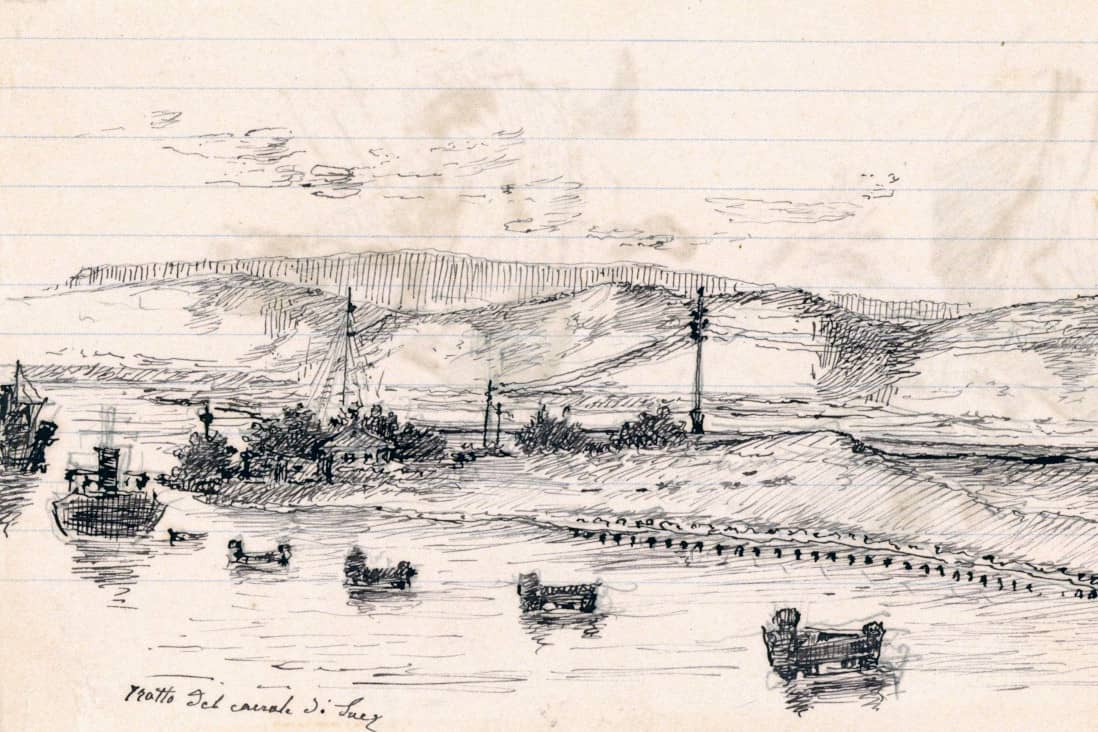
His confreres, who had set out in the early decades of the nineteenth century, had to circumnavigate Africa or undertake a journey overland. Tovini, however, was able to shorten the journey: his ship sailed through the Suez Canal, which had been opened some thirty years before his voyage.
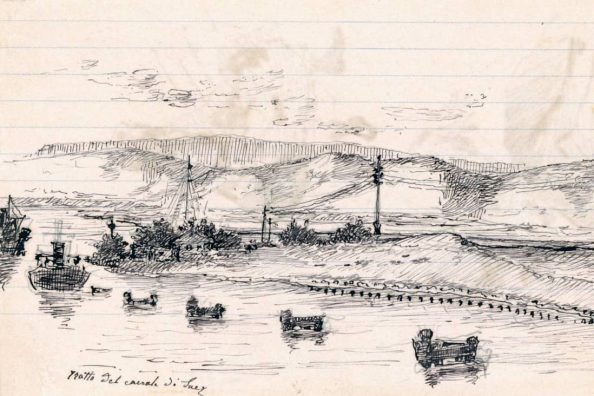
The scholastic Tovini did not merely keep a diary chronicling his journey; he also sketched the landscapes, people and animals he had the opportunity to observe. The drawing accompanying today’s instalment is his own; preserved alongside many others with his travel notes, they have managed to freeze time.
One can see men wearing fez hats, veiled women, and the attire of travellers.
Saturday December 3rd, 1898
It is the long-awaited and much-desired dawn of 3 December. It is the feast day of our patron saint, Francis Xavier: having therefore attended to our spiritual duties, we set off under the most auspicious of circumstances and accompanied by the prayers of our dear brothers towards the station. […] The pier is not far from the railway station, so after a short walk through a vast array of carts, carriages, goods and crates of every kind, we find ourselves within sight of our steamship. It is the Imperatrix: a large steamer belonging to the Austro-Hungarian Lloyd Company, which has more than 90 such vessels at sea; 106 metres long and 20 metres wide. There are first, second and third decks; we are on the second.
Tovini is very excited, as is evident from his words. He is very young; he is nineteen when he sets off and had entered the novitiate at seventeen, so he has only two years of religious life behind him. He has rarely left his hometown and suddenly, within the space of just a few days, he sees very different lands, peoples and customs. Consider his description of veiled Muslim women: “For the first time we come across Muslim women: they are all wrapped in their large veils and wear a bamboo tube across their noses from which hang pendants, just as they do from their ears and feet, etc.”; he also sees dolphins. His descriptions are obviously influenced by the climate of the time: the missions were colonies and Tovini writes from the perspective of a white man. As always, it is important to bear in mind the historical context in which the person lives and operates. Particularly interesting is the description of the entrance to the Suez Canal:
The departure, originally scheduled for before 4 o’clock, was delayed until after 7 to avoid encountering another steamer travelling through the Suez Canal at that time. We had scarcely weighed anchor when a marvellous and dazzling radiance illuminated the sea all around. It was an incandescent lamp of extraordinary size placed on the ship’s bow and powered by a large cable taken on board specifically for this purpose in this port. This light is necessary to avoid any danger of collision or running aground in the shallows found in the great canal. This opens up before our eyes precisely where the Mediterranean Sea ends, and we slowly make our way into it.
We are told that the journey will take 11 hours, as the route is 65 miles long and we must proceed at a speed of only 5 miles an hour. […] Having entered the canal at half past seven yesterday evening, we remained there all day today until 1 o’clock in the afternoon. […] On its banks we see several houses and factories, special boats designed to extract the sand that is gradually accumulating in the canal; further on to the right, rows of palm trees, and behind them the vast Egyptian desert, whilst to the left lies the red, fiery desert of Arabia.
Tovini’s travelogues is long and detailed; it runs to 48 handwritten pages in total, and we cannot transcribe it here in its entirety. While we wait for some scholar to decide to publish it, we shall reproduce a few passages written three-quarters of the way through the journey. On 20 December, the Jesuit arrives in Bombay on the west coast, but his destination is Mangalore, in southern India, where he arrives ten days later. It therefore took almost a month’s journey to reach his destination.
Tuesday 20th. Around 2 o’clock in the morning, having woken up, we got up to go on deck, as was the custom, and there, not far away, appeared the vast, illuminated city of Bombay. However, we could not see much because we were still outside the harbour. […] Father Minister leads us to a carriage and we cross the vast, beautiful quay, making our way along one of the city’s main streets. Our first impression was one of great wonder at the sight of people’s varied attire, the variety of plants adorning the streets, and so on; and every now and then, we would exclaim, “We’re in India!”
The India that Tovini sees is the colonial one: the architecture, for example, was strongly influenced by the English style, from which India gained independence in 1947. Unfortunately, Tovini never got to experience this new chapter in the history of the land he describes with such enthusiasm: he died in Brescia in 1904.
As we have seen, since these are personal travelogues, the style is very different. When Ponza set off for Brazil, he was 56 years old with a full forty years of religious life behind him; he had a long list of objectives and perhaps even intended to document the journey, at least initially, but this desire later faded. Tovini, on the other hand, was 19 years old and had only just left the novitiate. The sources are therefore influenced by personality, the time available for compilation, and the respective conditions of the journey.
These two case studies are merely two examples. Our historical archive, in fact, holds thousands of personal files of Jesuits, and although not all of them kept a diary, one frequently finds memoirs, notes and notebooks on experiences related to the apostolate.
Maria Macchi