Companies and suppliers
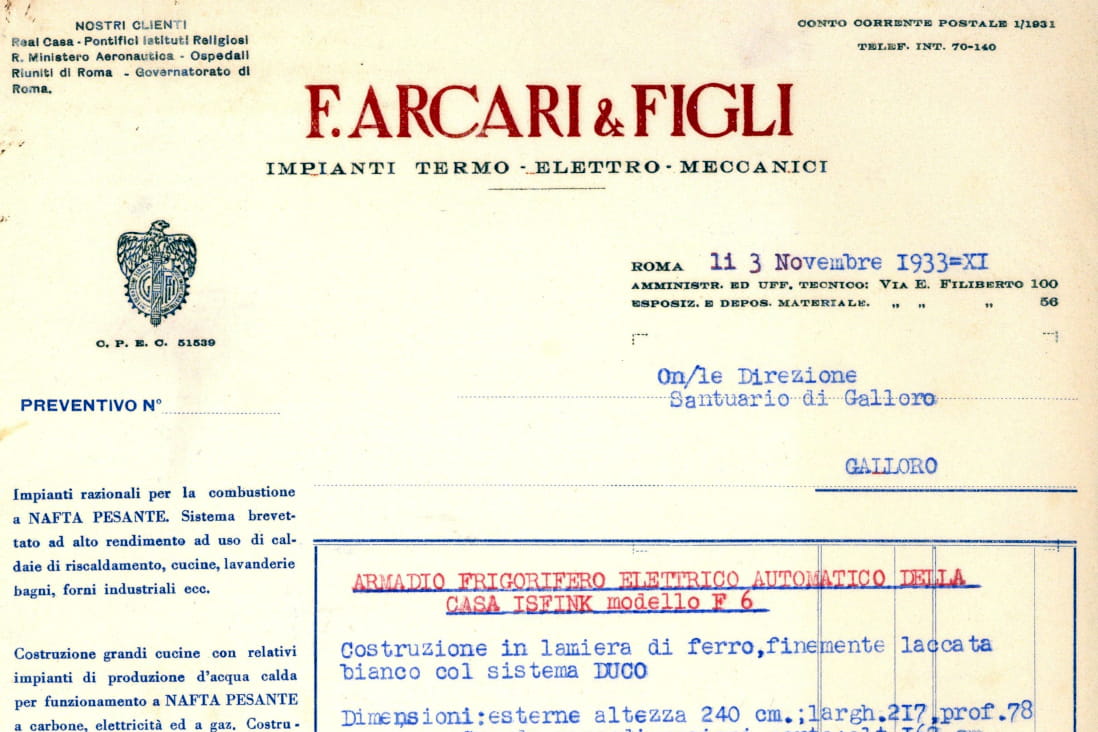
Our archive does not merely preserve sources on the religious life of the Jesuits or their apostolate. There are many documents, arising from the day-to-day life of the residences, which could be useful to those studying the history of companies and firms that no longer exist, the work of laypeople, and even the history of advertising.
What does the archive of a religious order have to do with company documents?
Not all firms of the past have kept their own historical archives. Of course, they all had their own day-to-day records, but the vicissitudes associated with the closure of a business have not always allowed these to be preserved and passed down to us. Weather events, wars and fires have often prevented the preservation of many firms’ documents.
Invoices and quotations
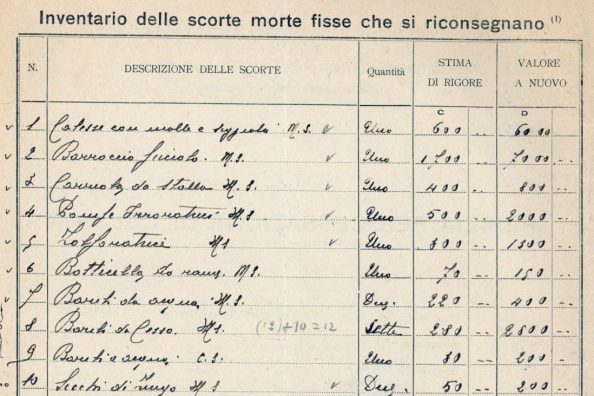
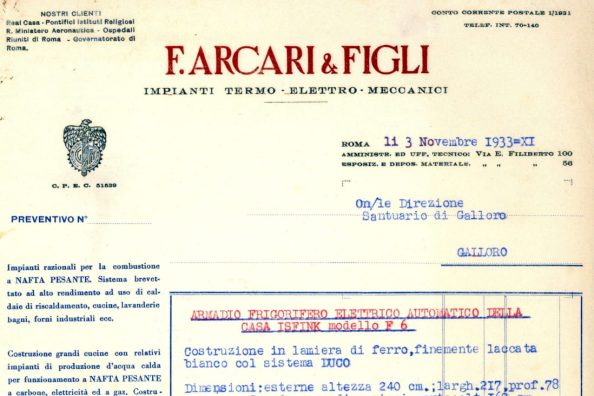
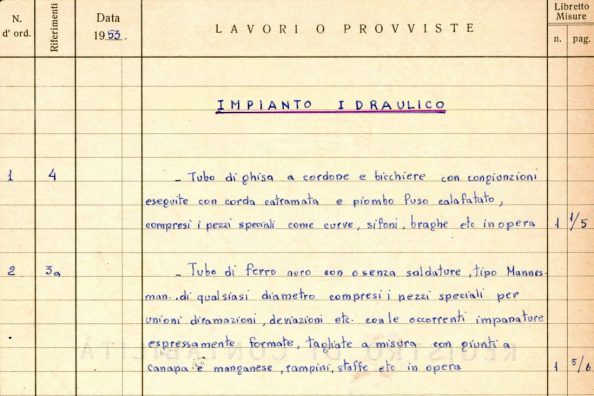
Naturally, our archive does not contain the founding documents of the companies, which were instead held in their day-to-day archives. However, we do have the quotations, invoices, brochures and sample books that they sent to their clients. These clients were, in fact, the provinces or the individual residences and colleges of our historic Provinces.
Indeed, despite having the great professionalism of the Jesuit brothers at its disposal, the Society could not have met all the needs related to renovations and the replacement of dilapidated furnishings in residences and colleges relying solely on its own workforce.
Each province, through its finance office, needed to contact companies and professionals to make use of certain services and purchase the necessary materials, particularly during the 20th century.
Orders, invoices and company brochures are preserved in the records produced by the provincial finance offices. Today, in particular, we are making use of the recently reorganised records of the Romana finance office.
This is a vast amount of material, having survived previous rounds of disposal. Indeed, invoices, just as in our daily lives, were considered ephemeral documents, to be kept for a limited period of time. In some fortunate cases, however, they were not destroyed.
Studying advertising
For those studying the history of advertising and how the promotion of goods has evolved, particularly between the 19th and 20th centuries, invoices are often invaluable documents. Indeed, in these documents we find the company’s trade mark, any logos, or useful information on the type of products and services provided. It was often in the invoice header that companies specified they were official suppliers to the Holy See or to royal houses, or stated the year of their foundation. Photographers in the 19th and early 20th centuries also used the back of their photographs to advertise their services: some mention having backdrops of every kind, others mention providing parking for carriages, and others still mention offering quick photo prints.
We often find product brochures attached to invoices and quotations: furniture, kitchens, and household appliances. These documents also tell us how interior design trends evolved, and what was offered to religious institutions needing to furnish a residence or a retreat house. They also tell us how much, for example, the kitchens of these residences have changed; over the course of the 20th century, they acquired increasingly cutting-edge equipment, and the advertising makes this clear.
“Adopt the Duplex electric potato peeler: economy and less waste, as well as faster, less cumbersome work and more,” reads one of the brochures for kitchen appliances aimed at hotels and large religious houses.
Not just small and large businesses
The documents often reveal the local context in which colleges and residences were situated. As in the case of the supplier of 500 eggs to the community of Castel Gandolfo, or the female workers – such as seamstresses and embroiderers – whom the communities employed. In fact, the presence of a college or residence offered a real opportunity for lay people to find work: teachers and caretakers in the colleges, domestic staff in the larger residences. Schools also frequently commissioned photographers for end-of-year photos or for recitals and academic ceremonies. The Society’s major projects provided a steady stream of work for local tradespeople.
Among the documents in the bursar’s records, we also find lists of the names and surnames of the ‘local’ professionals and suppliers used by the Jesuits: plumbers, booksellers, and opticians. We focus on a statement of income and expenditure from 1920 for the Collegio dei Nobili in Villa Mondragone, which lists all expenditure items corresponding to a specific shopkeeper or supplier:
Albrighi, bookseller
Angelucci, cloth supplier
Funari, grocer
Jhonson, medals
Grifoni, wine
Alessandroni, stationery and printing
Nozzi, tinsmith
Paravia, bookseller
Pronti, eggs
Pharmaceutical Company,
Tamburrano, laundryman
Signorelli, bookseller
Turilli, television
Parisotti, optician
Salesian Bookshop
Chiesa, optician
Parisi, candles
Olandi, radiators
Simoncelli Leonilde, hosier,
Cruciani, bookseller
Magazines
Printed magazines can also be an excellent source for anyone wishing to trace specific companies and brands. In fact, very often, in order to cover printing costs, the editorial staff would include advertisements from certain companies and shops – genuine sponsors who paid to appear in print. This enabled college and charitable organisation magazines to cover their printing costs, particularly for colour printing, which was especially expensive.
Advertisements can be found in college magazines as well as in provincial publications; even *Missioni* used advertisements. The revenue generated in this way could also be used to fund the missionaries’ activities and meet the needs of the missions.
The magazines also allow us to observe the evolution of advertising at close quarters: from black-and-white images with sparse information to colour advertisements with carefully crafted slogans and detailed product information in the 1960s. One can often find the same product – toothpaste, shoe polish, soap – featured in the magazine in different years with completely different advertisements, allowing us to appreciate the evolution of product presentation.
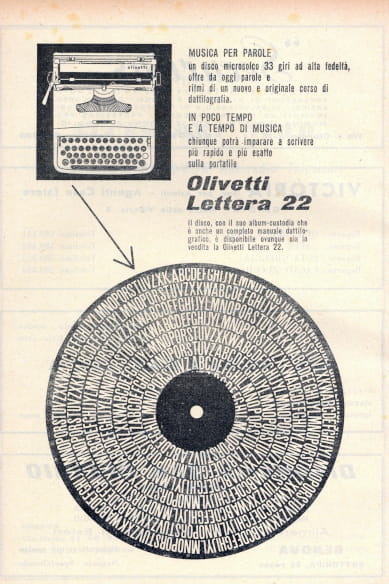
The image that concludes this instalment is taken from the magazine ‘L’Arecco’ – published by the college of the same name – and depicts products from the ‘Olivetti’ company; the advertisement dates from 1960.
Maria Macchi