Myths about the Jesuits, from the 16th century to Zerocalcare
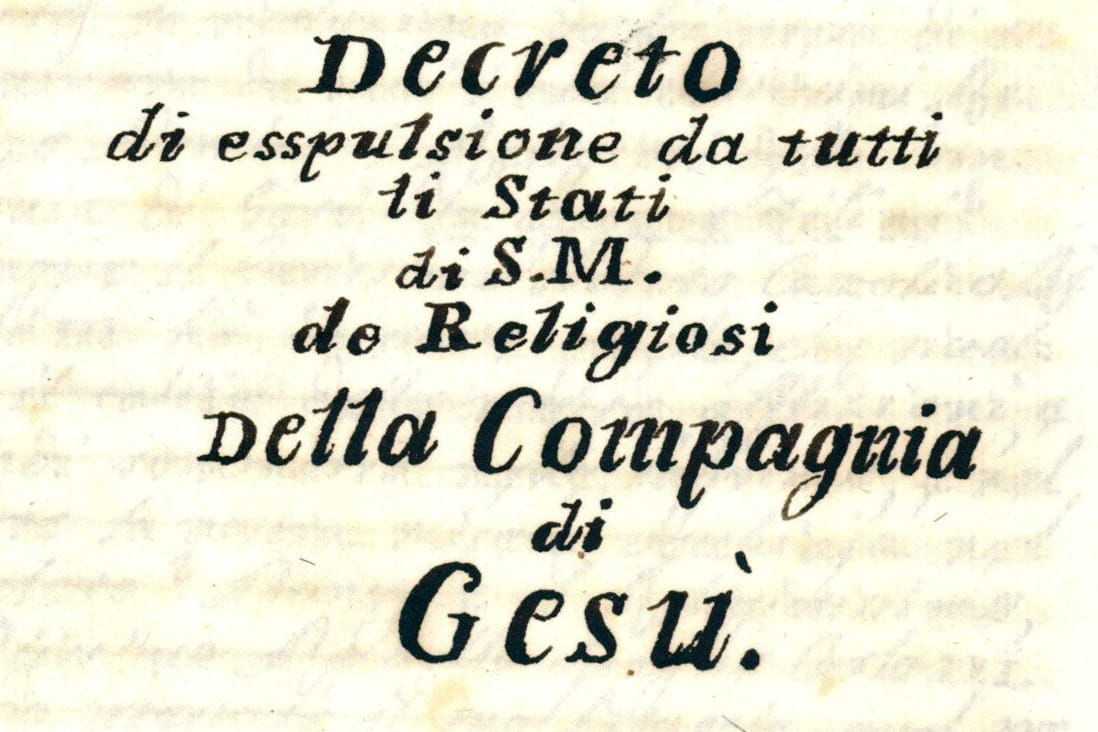
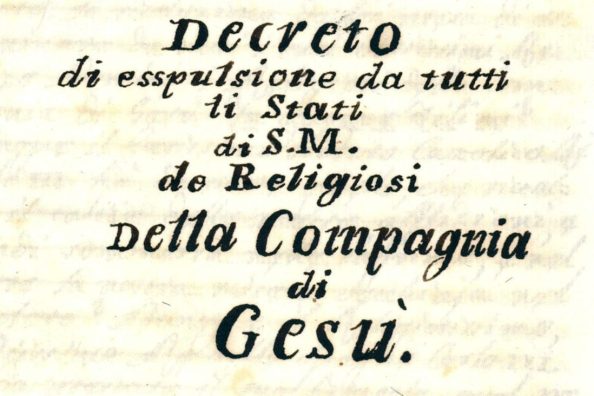
‘False like a Jesuit’ is a phrase that the Italian cartoonist Zerocalcare has used repeatedly in his works and in every season of his successful Netflix series. However, this is not his own invention. This stereotype is very old and forms part of the extensive anti-Jesuit literature, which spread particularly between the 17th and 18th centuries. Prejudices and anti-Jesuit literature contributed significantly to the expulsion of the Jesuits from European courts during the 18th century and to the suppression of the Order in 1773.
The origins
Prejudices against the Jesuits arose shortly after the death of St Ignatius. Indeed, as early as the second half of the sixteenth century, there were those who wrote that the Society had been founded by the devil and that the Jesuits were even murderers, traitors and thieves. By the end of the sixteenth century, the Jesuit was portrayed as a fanatical Catholic and a revolutionary, capable of inciting regicide. In 1599, the Jesuit Juan de Mariana published De Rege et Regis Institutione, in which he discussed the possibility for an oppressed people to depose their sovereign, even by violent means. This was a theory that had been widely used in the teaching of philosophy and theology for some time, but the publication gave rise to accusations of regicide.
We are only at the dawn of this long tradition of false myths, which would go on to become a literary genre in its own right.
It is not possible to pinpoint a single reason that motivated the Society’s detractors, who have been numerous and very diverse throughout history. Indeed, although the first false myths emerged just a few decades after the Order’s foundation, they have multiplied over the centuries, taking on meanings that are, to say the least, fanciful.
One of the ‘oldest’ reasons fuelling these prejudices is linked to the rapid spread of the Jesuits and their communities, which were particularly unwelcome in areas where Protestantism was gaining a foothold.
Let us try to trace the reasons that fuelled these prejudices.
A complex set of reasons
The conflict between the Catholic Church and other religious faiths contributed to the emergence of certain preconceptions, including that of the ‘false Jesuit’.
A case in point is that of the English Jesuit Henry Garnet and the Gunpowder Plot of 1605.
This was a failed conspiracy against the King and the English Parliament: a group of Catholics had planned to blow up the House of Lords during the opening ceremony of Parliament.
Some of the conspirators had approached Father Henry Garnet and his fellow Jesuits to go to confession, but the Jesuit could not break the seal of confession and reveal their intentions.
He was hanged along with other Jesuits on charges of having taken part in the Gunpowder Plot, even though the organisers’ confessions did not indicate his involvement.
The plot became known as the ‘Jesuit Plot’, although the followers of St Ignatius had neither devised the plan nor collaborated in it. At that time, however, tensions between Catholics and Protestants in England had flared up again, and the plot provided the king with a pretext to impose restrictions on Catholics and limit their practice of their faith.
This is where the association between ‘Jesuit’ and ‘ambiguous’ – understood as ‘false’ – began: because of Father Garnet’s inability to break the sacramental seal of confession, which was interpreted as lying, duplicity and falsehood.
Fake news of the past
Contrary to popular belief, fake news is not an invention of our time, but has always existed throughout history. One such instance concerned the Jesuits and contributed significantly to the legends surrounding them. The work Monita segreta, first published in 1614, revealed to the general public how the Jesuits managed to enrich themselves, win the favour of others, become more influential, keep an eye on their enemies and befriend the powerful.
The author enjoyed widespread approval, given that he was a former Jesuit, and the work saw no fewer than 300 editions over the following three centuries.
It is a pity that the content of the text was entirely fabricated: Zahorowski, being well acquainted with the Constitutions of the Society of Jesus, had in fact produced a completely different version, whilst retaining the original tone and style. Furthermore, the Monita contain the concept of ‘irrefutability’, according to which any Jesuit, if questioned on the matter, would have claimed never to have heard of these instructions or might have cited other Constitutions (in reality, the genuine ones), in order to discredit the Monita, which were presented as the Order’s sole document.
The Monita were so successful that they were still being cited as late as the late nineteenth century to discredit the Jesuits.
Laxity
One of the most enduring accusations was that of laxity, a charge later taken up by Blaise Pascal. In fact, from the very foundation of the Order, the Jesuits were staunch advocates of the need to go to confession and receive the Eucharist frequently. To ensure the proper training of confessors, they wrote books on ‘cases of morality or conscience’, which became a distinct branch of moral theology but were interpreted by the Jesuits’ detractors as a means of justifying immoral behaviour. Even in our sources, although produced in the nineteenth century, references to such moral cases—which were submitted to Jesuits in training—are frequently found in the Order’s diaries.
Hence the accusation of laxity: the Jesuits were said to have justified every sin of the faithful in order to lead them to the Eucharist and therefore, according to the rigorists, were guilty of undermining morality and ‘invalidating’ the doctrinal teachings of the Catholic Church.
Both Alexander VII and Innocent XI subjected the writings of certain Jesuits to censorship on charges of laxity.
The Jesuits were accused of being lax themselves and of paying little attention to morality.
Blaise Pascal and the Jansenists
Many of these prejudices converge in the figure of Blaise Pascal. The philosopher, a staunch supporter of Jansenism, accused the Jesuits of distorting the Gospel message by separating Christian morality from the love of God, and of promoting laxity through casuistry.
He wrote the famous ‘Provincial Letters’, in which he took up various Jansenist theses according to which not all human beings were destined for salvation. He contrasted rigorism with the morality of the Jesuits, which, in reality, was not ‘accommodating’ by nature but assessed the nature of the sin committed, the context and the circumstances. According to the Jesuits, the confessor should always take these aspects into account when dealing with a member of the faithful, rather than merely imposing the harshest penance. The casuistry was a tool that the Jesuits made available to confessors precisely to ensure that the faithful went to confession frequently and were encouraged to receive the Eucharist, and thus might believe in salvation.
This message was completely misrepresented and branded as lax.
Chinese rites, the accommodatio and the reductions
Other criticisms of the Jesuits relate to certain methods employed by the missionaries which, over time, were misunderstood and condemned.
The issue of the Chinese rites – and those of Malabar – was also taken up by some Jansenists as an example of the Jesuits’ laxity.
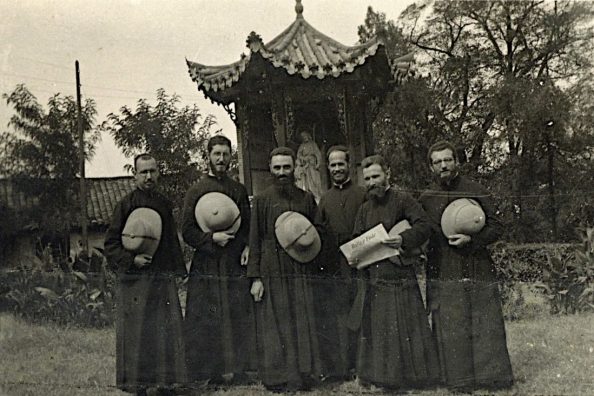
In China, as well as in other mission territories, the Jesuits made use of the accomodatio and Chinese rites: a series of practices designed to communicate the Gospel whilst reconciling it with local cultural traditions, without eradicating or condemning them, particularly with regard to the worship of ancestors. According to Father Matteo Ricci and his fellow Jesuits, these traditions were not the result of superstition but were very close to the Western concept of pietas and respect for the dead.
The Jesuits also sought to make the Gospel message more universal so that it would not be perceived as a Western or European religion but as a message intended for the whole world. This was a very modern approach, but one that was not in keeping with the thinking of the time.
These methods drew criticism even from the contemporaries of Father Matteo Ricci – other religious orders had pursued practices of inculturation that were far less respectful of local cultures, to the point of leading to a formal condemnation by the Church.
The reductions also contributed to making the Jesuits unpopular, particularly in Spain and Portugal.
These were small communities founded by the Jesuits in certain mission areas of South America, where the indigenous population lived under protection. The aim of the mission was not only to evangelise but also to improve living conditions. Schools were opened in the reductions; the tribes settled in one place, were not enslaved, and their work was regulated so that they could enjoy adequate rest. The Jesuits made use of music, which became one of the defining features of the reductions and is still widely studied today. Although not without their problems or criticisms, they stood out as an apostolic experiment aimed at protecting the indigenous peoples.
However, this form of government and independence for the local populations – protected and managed by the Jesuits – did not meet with the approval of Spain and Portugal, which had colonial interests in those lands.
The Jesuits were accused of protecting the reductions because they were situated on lands rich in gold, and of being advocates of a form of independent government.
Thus arose the legend of a mythical Jesuit empire linked to the reductions and the Guaraní.
From 1750, with the Guarani War, the reductions were attacked, their inhabitants persecuted and enslaved. A few years later, the Jesuits were expelled from Spain and Portugal.
The movie Mission recounts precisely the events linked to the reductions.
The Jesuits and Education
There is another reason which, for a long time, fuelled resentment against the Jesuits, and it is linked precisely to the colleges. The rapid spread of Jesuit-run colleges often pitted members of the Order of St Ignatius against other religious orders involved in education, which saw their enrolment figures decline.
The growth of the Order and the large number of Jesuits registered in the decades following its foundation had already caused discontent amongst the diocesan clergy and other religious orders, who resented the competition posed by the colleges of St Ignatius.
This is an issue that has recurred periodically.
We find traces of it again in the nineteenth century, for example in Velletri, where a full-blown riot broke out against the Jesuits.
The records preserved in our Archives reveal that popular discontent had been fuelled by the diocesan clergy and other religious orders competing with the Jesuits, who had a college in Velletri itself.
Educating high society
Another aspect of this story is linked to the stereotype of the wealthy Jesuit.
This stems from several factors: their relationship with benefactors, the education of the offspring of European families, and the role of confessor to kings and queens held by various Jesuits.
It was St Ignatius himself who established a rule for the Society’s colleges: to open an institution, funds must be secured. Initially, the colleges were intended to be free of charge, and so it was essential to have benefactors.
Throughout his life, he personally maintained a prolific correspondence with a great many benefactors who financed the opening of the colleges.
This rule prevented ambitious projects, such as the opening of schools, from placing a long-term strain on the Society’s finances and diverting funds intended for the apostolate. However, St Ignatius himself realised that benefactors would often wish to exercise control over the colleges.
The Jesuit colleges, which later became private and fee-paying institutions, were attended by the aristocracy and the upper middle classes. The Jesuits also served as tutors to the offspring of ruling royal families.
They were also frequently chosen as confessors to many members of the royal family. Their proximity to the court and to those in power has, over time, fuelled the notion that the Jesuits could influence the decisions of the governments of the former Italian and European states, and that this was, in fact, one of their very aims.
In reality, the Jesuits served as private tutors because they were highly regarded as teachers. In the Leopardi household, for example, there was a Jesuit tutor; this was during the years of the suppression.
For every Jesuit confessor to the King of France, there were hundreds engaged in hearing the confessions of the faithful throughout the nation and in the missions. In addition to its colleges, the Society of Jesus also opened evening schools, recreation centres and orphanages, and devoted itself to the education of abandoned and vulnerable children. Schools in the missions, for example, were completely free of charge.
Other prejudices
The notion of the ‘false Jesuit’ is also linked to the Ignatian style and its pedagogy. According to a saying – again the result of stereotypes – a Jesuit answers a question with another question.
In reality, the Ignatian method – on which the Spiritual Exercises are also based – encourages knowledge, curiosity and the constant questioning of one’s experiences and how they resonate within oneself, in order to continually deepen one’s understanding of oneself and one’s surroundings. The ultimate aim is the development of the individual and their critical faculties.
This is why the Jesuit, particularly in his role as a spiritual guide, poses questions as an exercise in self-reflection and introspection regarding one’s relationship with God.
In the nineteenth century, the belief then spread that the Jesuits taught that the end justifies the means and that, in order to achieve a just end, one may even commit immoral acts. This is a distortion and misinterpretation of an example, which falls precisely within the ‘casuistry’ mentioned by Fr Busenbaum. Various studies, including those carried out by the Jesuits themselves, have shown that neither this phrase nor this teaching exists in their texts or in Ignatian pedagogy. On several occasions, sums of money were even offered to anyone who could find the quoted phrase in a book authored by a Jesuit; the sum was never claimed.
The Jesuits’ Responses
The Jesuits, however, did not stand idly by. There is a vast body of texts, pamphlets and speeches produced in response to anti-Jesuit literature. Some of these are also preserved in our historical archive. Prejudices against the Jesuits did not end with the Suppression. Indeed, this story does not end in 1773; the false myths survived and persisted into the nineteenth century, taking on further nuances.
Anti-Jesuitism after the suppression
During the nineteenth century, various anti-Jesuit pamphlets and texts from the past were reprinted, perpetuating the false myths about the Jesuits. There were also new works such as “The Wandering Jew” by Eugène Sue, which helped to fuel the notion that the Jesuits were deceitful and greedy for money. It should be noted that this is a novel, a work of fiction, yet one capable of fuelling the anti-Jesuit debate.
One of the themes that emerges from this work is the ‘sectarian’ aspect: the Jesuits were increasingly portrayed as a secret order controlling the world, even said to have their own police force with an archive in Rome. This new element was sometimes used to brand members of the Order of St Ignatius as reactionaries, pro-monarchists and at the forefront of efforts to hinder the emergence of republics or the overthrow of absolute governments. This was one of the accusations levelled by Vincenzo Gioberti, for example. At other times, however, they were accused of supporting the republicans.
In the 1880s, Jews were at the centre of a smear campaign based on the so-called Protocols of the Elders of Zion, which shared several points in common with the anti-Jesuit tradition.
The Black Pope
It was precisely from the mid-19th century onwards that this epithet came into widespread use to refer to the Superior General of the Jesuits. ‘Pope’ because, according to the Constitutions, the Father General is elected for life, whereas in all other religious orders the office is held for a limited period of time. This similarity with the election of the Pope has, in fact, been fading for some years now: indeed, both Fr Kolvenbach and his successor, Fr Nicolás, have chosen to resign from their posts upon reaching the age limit. The adjective ‘black’ served to distinguish the Superior General of the Jesuits from the Pope, who, by contrast, dresses in white. Although the Jesuits have never had a specific habit, as the Franciscans or Dominicans do, they usually dressed like the diocesan clergy, and therefore in black. This expression certainly originated in the nineteenth century, as there is no trace of it in the ‘Ancient Society’, and it probably arose from certain short stories.
However, the expression ‘Black Pope’ also suggested a politically ambiguous aspect of the Superior General.
In the nineteenth century, in fact, the Society’s detractors accused its members of being reactionary, anti-modernist and opportunistically always in favour of the Holy See, mindful of the Society’s suppression; in short, of being ‘more royalist than the king’.
We find a depiction of this in themovie “In nome del Papa re” (” In the Name of the Pope-King”), which offers a fictionalised account of the legal case involving Monti and Tognetti, the perpetrators of an attack on the barracks of the Papal Zouaves. In the movie Monsignor Colombo, portrayed by Nino Manfredi, comes into direct conflict with the Provincial Superior of the Jesuits, who represents the conservative wing of the Catholic Church – a petty figure who dissuades the Pope from granting forgiveness in order to preserve his own power and that of the established authority.
Even in a more recent adaptation, “L’ultimo Papa Re” (2013), in which the role of the cardinal is played by Gigi Proietti, the figure of the ‘Black Pope’ appears in the same negative light.
From being a synonym for a regicide and a defender of the independence of peoples in missions carried out to the detriment of sovereigns, in the nineteenth century the Jesuit became the archetype of a reactionary and an enemy of the nation.
The Jesuit Oath
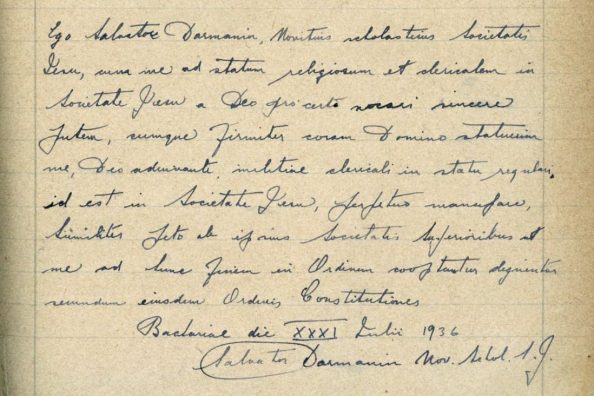
Another legend about the Jesuits – perhaps the most curious – is firmly rooted in the anti-Jesuit tradition and relates to their oath. Forged documents containing information on the Jesuit oath were produced around the 17th century, yet this topic has always aroused widespread interest amongst the general public and has resurfaced from time to time over the centuries.
Even today, one can still find online accounts of so-called ‘mysterious oaths’ allegedly taken by members of the Society of St Ignatius during their Final Vows, in which they are said to pledge obedience to Satan whilst performing gestures mimicking the slitting of the throat and other symbols of wickedness. These so-called oaths have led several people, over the last few years, to write to us asking whether what they had read online was actually true.
We have therefore decided to devote an instalment of our column specifically to the Jesuit oath, transcribing the formula in both Latin and Italian, and demonstrating that it bears no resemblance whatsoever to what can be found online.
Furthermore, the Jesuits’ Final Vows take place during a public Mass, in the presence of family, friends and relatives, as well as fellow members of the order.
The only aspect kept confidential is the rank of the Final Vows for Jesuit priests: spiritual coadjutor or professed with four vows. This aspect, which in the past was known as the ‘secret vow’, has fuelled this dark legend.
Whilst the Jesuit is alive, this information is kept confidential simply to avoid creating inequality amongst his fellow Jesuits. The details can subsequently be accessed in the archives by scholars.
Today, this in-depth article on the oath is the most-read piece in our column.
Find out more
In this episode, we have looked at some of the stereotypes surrounding the Jesuits, touching on the various reasons that have fuelled them, but the subject deserves further exploration.
There are numerous studies on anti-Jesuit literature and its popularity over time.
For those wishing to explore the subject further, we recommend starting with the entry ‘Anti-Jesuitism’ in the Diccionario Histórico de la Compañía de Jesús, from which many of the points discussed in this episode are drawn. This is a major work, published in 2000 in Spanish, which sought to provide a compendium of the most important themes relating to the Society, with entries on individual Jesuits, the missions, and distinctive aspects of the Order. The Diccionario is one of the primary historiographical sources consulted by our scholars for their research.
The entry on anti-Jesuit literature traces the history of these prejudices, listing many of the works written against the followers of St Ignatius across various historical periods.
One of the most recent and interesting volumes to have shed light on these issues is by Sabina Pavone, entitled “Le astuzie dei gesuiti” (The Jesuits’ Tricks), published in 2000.
Further contributions on the subject can also be found in the Jesuit bibliography.
As we have seen, the myths about the Jesuits die hard; they have five hundred years of history behind them and have even reached Zerocalcare.
We like to think that if the Roman cartoonist were to come across our column, he would have plenty of material to dispel the prejudices about the Jesuits and perhaps tell a different story.
We thank him for providing us with the inspiration to write this in-depth piece.
Maria Macchi