The canonical visit
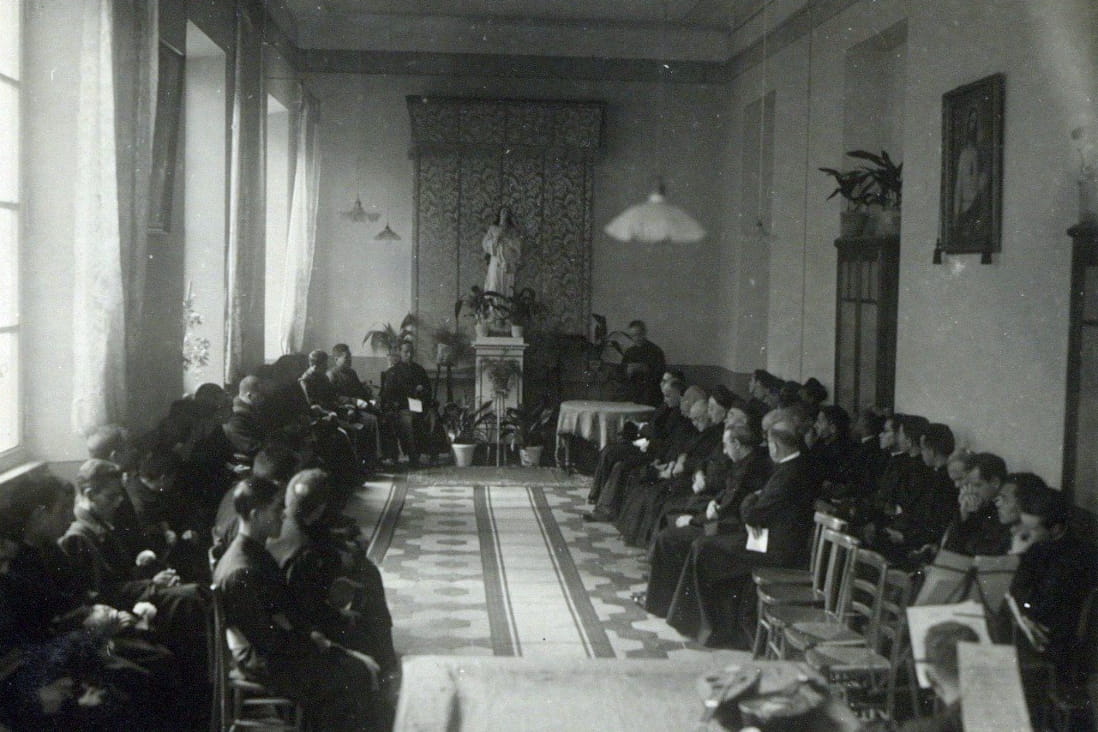
What does the canonical visit involve? How was it organised in the past, and how does it differ from today’s visits?
The canonical visit enables the Provincial to visit, once a year, all the communities in the Province and to meet individually with all the Jesuits who belong to it.
The Work of the Provincial
A Provincial has a wide range of responsibilities: governing the Province, maintaining contact with the communities, the works and individual Jesuits, holding consultations and meetings with all bodies, corresponding with the Superior General, the Holy See and the Bishops, and meeting with associations and institutions both within and outside the Society of Jesus.
Precisely in order to remain close to all the communities within the Province’s territory and to stay up to date and informed about his fellow Jesuits, their activities and their works, the Provincial has an important tool at his disposal: the canonical visit.
This is not the only means at his disposal: he also makes use of the historiae domus which each community sends him annually, as well as the assistance of his fellow Jesuits specifically appointed to assist him in certain areas, such as delegates and consultors.
Both the canonical visit and the *historia domus* are time-honoured tools, already envisaged by St Ignatius to ensure that the Father General – through correspondence with the Provincials – had an in-depth understanding of the state of the Provinces of the Society of Jesus and, above all, received regular updates. In fact, right up until the early decades of the 20th century, both the litterae annuae and the historiae domus were written. The former were reports sent annually by each community to the Provincial and the General, whilst the latter were submitted every three years. In this way, both the Provincial Curia and the General Curia were kept fully informed of the apostolate, the needs and the work of the brothers in every residence, with updates provided at short notice. It is precisely thanks to these sources that researchers today can carry out studies ranging from the restoration of churches to the customs of daily life.
The characteristics of the canonical visit
The canonical visit serves not only to visit the community but also to gain a better understanding of the needs of the fathers and brothers – not merely material ones – and to determine whether it is appropriate to assign more Jesuits to the house and its work.
When making the annual assignments, in fact, the Provincial will also draw on the canonical visit to allocate Jesuits to residences in need of additional members.
The canonical visit, which, as mentioned, takes place annually, is organised well in advance and may last several days depending on the number of Jesuits living in the community and the works being carried out there. Visits to infirmaries, for example, take longer because the Provincial also meets with Jesuits who are praying for the Church and the Society of Jesus. In the past, the Delegate assisted him for the Elderly, and today by the Delegate for Pastoral Care. Each Province organises itself differently with regard to delegates.
As the Provincial often had to stay overnight for more than one night, many communities had a ‘Provincial’s room’ – a room that was not used for the rest of the year but was always kept ready for him, both for the canonical visit and for overnight stays necessitated by long journeys within the Province. Some of our communities still have this room.
In this episode, we shall see how the canonical visit has changed since the nineteenth century and how it is conducted today.
The canonical visit in the nineteenth century
We are in Loreto, at the Collegio Illirico Lauretano of the Society of Jesus; 30 April 1836 marks the first day of the canonical visit.
The house diary mentions the arrival of the Provincial, travelling from Spoleto, and notes that ‘upon his arrival, the bell was rung to signal our community to come out to meet him’.
The canonical visit reflects both the Society and the society of the time. Upon the Provincial’s arrival – as the diaries of all the residences tell us – the community is found lined up outside the residence or on the steps leading to the college, in hierarchical order: first the Superior, then the Minister, down to the lay brothers. Even the household staff, attendants and servants, receive the Provincial.
It should be remembered, in fact, that in the nineteenth century and even into the first half of the twentieth century, specific protocols for the reception and visit of the Provincial were in place.
His fellow friars regarded themselves as his subjects, and the obedience owed to the Provincial was absolute. In this respect, the principles of the absolute states of the Ancien Régime were mirrored; these were times still far removed from democratic thought. In letters, for example, the Provincial was addressed as ‘Your Paternity’.
Let us read the extract from the Loreto house diary, which recounts the canonical visit, carried out the following year, focusing on the various commitments involving the Provincial and the community:
6 April. The Reverend Father Provincial wrote that he would arrive this evening at two o’clock in the night. He arrived at half past ten astronomical time. 7 Friday The usual exhortation to the boarders was omitted, and the novena was brought forward on account of the opening of the Visit. The bell was rung for the litanies a quarter of an hour earlier than usual; these were led by the Minister in the chapel, where the Blessed Sacrament had first been exposed; and then the Reverend Provincial opened and inspected the ciborium, the monstrance and, finally, the vial of holy oil.
8 Saturday […] Catechism lessons for the servants, which today began at three o’clock after lunch, as there was no longer sufficient time in the evening. After lunch, there is a break from lessons granted by the Reverend Father Provincial; the other half-break, to make up the full usual break given on such occasions, will be on Thursday morning.
[…] 9 Sunday: Solemnity of the Most Holy Annunciation for our day pupils. A grand celebration was held in the chapel, organised by the pupils: chocolate was served to the celebrants and choristers in the morning, and lemon treats after lunch. In the evening, the novena concluded with the recitation of the ‘corona dei fioretti’ – a prayer made up of short prayers – prepared by the boarders on the previous day, and with the offering of the new ones: as the piano was in the chapel for the service attended by day pupils, the boarders sang the litanies accompanied by Maestro Prosperi on several occasions over the past few evenings. The rosary was very edifying.
10 April The Reverend Father Provincial went to visit the villa at St Jerome’s. 12 A full day off instead of tomorrow, as decided by the Reverend Father Provincial, who addressed our community before leaving for Fano; it was half past nine astronomical time. Having embraced everyone, he departed at around half past ten.
A few years later, Fr. Angelo Secchi , who was then serving as a teacher, would be assigned to this community.
The Provincial’s duties during the canonical visit
The Provincial’s visit, as the account taken from the Loreto diary shows, was not limited to discussions with his confreres. In fact, he was involved in the life of the communities and the day-to-day running of the college.
It was an important opportunity to showcase the college’s achievements and the fruits it reaped from its pupils: through essays, literary works, and choral and musical performances. We also find some echoes of this in the visits carried out as late as the first half of the 20th century, when the pupils at the Arici boarding school in Brescia produced a notebook to present to the Provincial.
Inspecting the house register
During the canonical visit, the Provincial would usually ask to see the house register: he would check that it was well maintained, that there were no gaps, and would initial the last page to certify that it had been read. This check was very important because it ensured that the house diary – which is now one of the most useful sources for our researchers – was always kept in order and up to date. The check was necessary because the Jesuit responsible for keeping the house diary, chosen by the Superior, changed frequently, sometimes even during the course of the year. These were Jesuits in formation, and as their style varied from person to person, it was important that the diary be not neglected. Furthermore, the house diary served as a starting point for compiling the historia domus and was fundamental to the community’s collective memory.
It is precisely the house diary that allows us to retrace the packed schedule of visits.
Admonitions and suggestions
Furthermore, the Provincial observed how the house was run, whether it was clean or not, and the atmosphere amongst the confreres.
If he noticed anything that did not comply with the rules or customs, he might issue some admonitions: brief messages addressed to the community to remedy the shortcomings identified.
It is precisely these documents that help us to see the work carried out by the Provincial during his visit, and to follow his perspective.
Let us read some observations that the Provincials left for certain communities between the 19th century and the first half of the 20th century.
The Provincial of the Veneto–Milanese Province, following his visit to the community in Gorizia, wrote:
Take care not to incur unnecessary expenses.
It is recommended that the Rule of Silence be observed, especially in the kitchen and the vegetable garden, and that the common signals be strictly adhered to.
The Superior is advised to ensure that no books from the library are given to or lent to outsiders by anyone in the house.
The Provincial of the Turin Province, at the end of his visit to Chieri, addressed his confreres with these words:
Use larger candles for Masses so that there may be more light
Have the chalice used daily gilded
Wash or change the carpet on the table and in the sacristy
For the refectory
At the small table, it would be good for everyone to sit with their heads uncovered, both for the sake of the act of humility and in accordance with ancient custom.
These documents, together with the customs, allow us to gain a better understanding of the daily life of the Jesuits of the past, with their everyday tasks, both large and small.
The Provincial’s duties following the canonical visit
These are not the only documents that bear witness to the canonical visit.
Once he had taken his leave of the community and returned to his office, the Provincial would draw up – and still does today – various documents. He writes a letter to the Father General to inform him of the visit he has just carried out and to update him on the work of the Jesuits and the needs of both the community and the mission. He then writes a letter to the community to thank the fathers and brothers for the visit and to offer suggestions or admonitions.
Both letters are sent: one addressed to the General Curia – today that document is held at ARSI – and one to the community. However, in our archive, we often find both documents, in copy form; in the latter case, we also have the original in the community’s fonds, if that community has since closed and the papers have been transferred to our historical archive.
The canonical visit today: a fewdifferences
Even today, the Provincial carries out these visits annually, travelling once a year to every community in his province.
During this visit, he not only receives a report from the Superior, but also from the entire community gathered and from the individual Jesuits he meets personally: he has the opportunity to visit the colleges, observe daily life in parishes and associations, and usually celebrates a closing Mass.
Unlike in the nineteenth century, however, the entire community assembled no longer receives him: many brothers are busy with schools or confessions and join him only for community meetings. Furthermore, over the course of the twentieth century, certain customs have fallen by the wayside, such as submitting the house diary to the Provincial, which is often no longer written.
The Provincial does not leave written admonitions during the visit but includes them, if necessary, in the letter addressed to the community.
Sources
Which sources are available to researchers wishing to learn about canonical visits?
If one is interested in a specific residence, one can consult the house diary, which, a few weeks or days beforehand, will highlight the preparations for the canonical visit and subsequently describe how it unfolded.
If, on the other hand, one wishes to reconstruct the Provincial’s schedule, one can start with the minutes of the consultations, which record the various canonical visits carried out in the communities, as well as the decisions that the Provincial gradually reaches together with his consultative body: the postings of Jesuits, the closure or opening of a community, and the commencement of urgent works in certain colleges.
The canonical visit can therefore be examined from two different perspectives: that of the Provincial – thanks to the council minutes, correspondence and provincial diaries (though these exist only for some Provinces) – and that of the residence, thanks to the archival collection it has produced.