Recounting the Earthquake
Disastrous natural events such as earthquakes or floods have also left their mark on the records of religious orders. Some of these records originate from residences that were severely damaged by an earthquake.
Our archive, for example, holds two collections from L’Aquila, which was struck in 2009 by a powerful earthquake that claimed the lives of 309 people: the collection of the Collegio degli Abruzzi and that of the residence in L’Aquila. Once the people had been brought to safety, the archival collections were also recovered, bearing witness to the history of thousands of students at the college and numerous Jesuits who lived in the capital of Abruzzo.
It is not uncommon to find traces of seismic events or dramatic weather events in some historia domus or in letters. On many of these occasions, the Jesuits were part of the relief efforts, organising the reception of displaced persons and providing hospitality. In the case of the Polesine flood, the Society of Jesus was part of the vast organisational effort aimed not only at relief but also at the reconstruction of the local areas and the social life of the population.
From the diary of Lorenzo Rocci
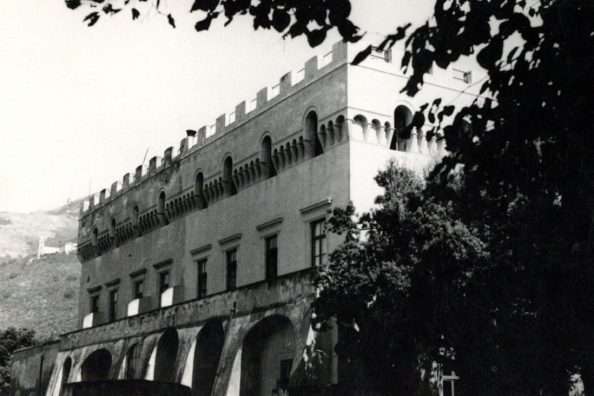
Lorenzo Rocci, for example, recounts in his diary having seen the ruins of Casamicciola, destroyed by the 1884 earthquake. He mentions several earthquakes he witnessed: one on 1 November 1895, which caused no damage, and another on 19 July 1899. This tremor, he tells us, caused damage to the Vignola portico at Villa Mondragone, and it was necessary to place an iron chain beneath the arches.
In December 1908, Rocci notes: “On the Feast of the Holy Innocents, a terrible earthquake destroyed Messina and Reggio Calabria”.
A few years later, he had the opportunity to see the devastation of Messina with his own eyes, and wrote: “Visiting the ruins, I see that the newspapers did not exaggerate in describing the catastrophe in Messina: it is said, and it seems true, that no more than four or five houses were spared”.
In the following years, he recorded a dozen or so minor tremors that he felt whilst living in Rome.
Raccontare il terremoto
Let us take a closer look at an account of an earthquake taken directly from a news report found in the archives, during the reorganisation of the Neapolitan Provincial Collection.
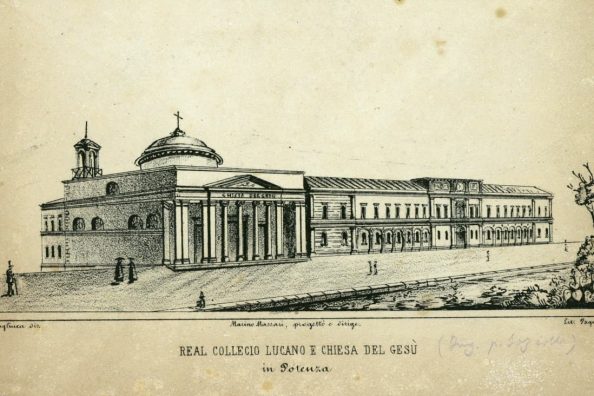
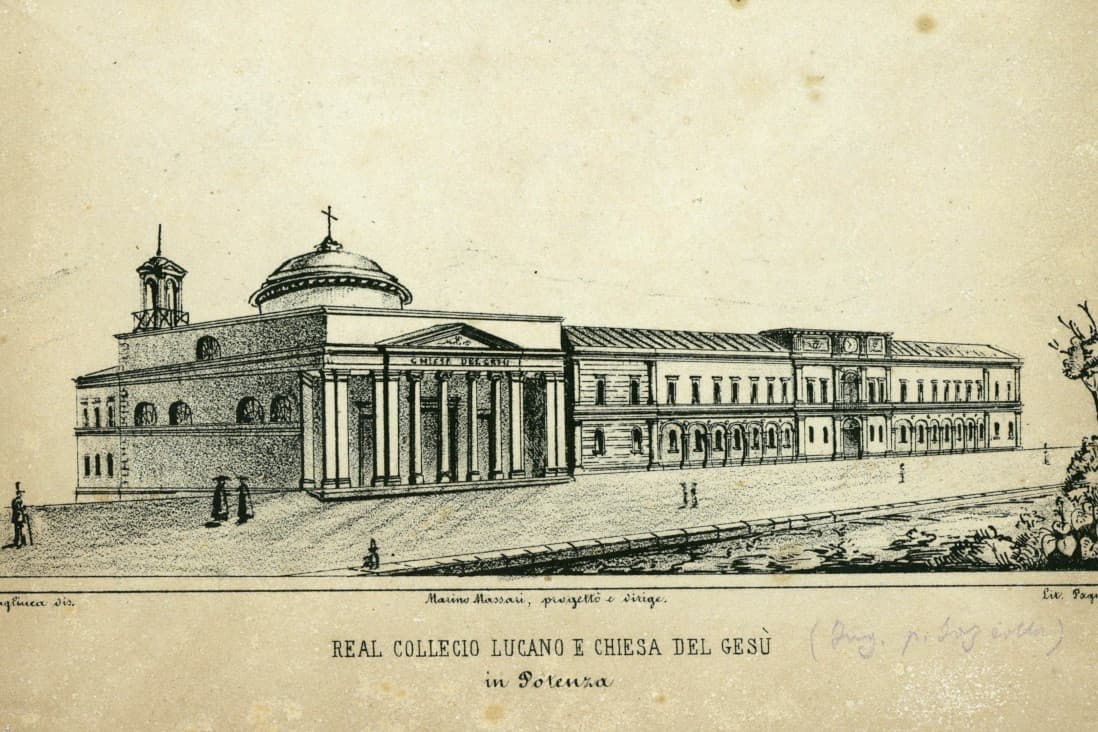
In Potenza, on the night of 16 December 1857, a devastating earthquake struck the region of Basilicata. At the time, it was not yet possible to estimate its magnitude—now measured on the Richter scale—nor the extent of the devastation, which only decades later became the subject of studies by Mercalli, who theorised the scale bearing his name. In retrospect, it has been classified as having a magnitude of 7.1 and an intensity of XI on the Mercalli scale. The number of victims and the devastation of numerous towns and villages make it one of the most devastating earthquakes of modern times. The 1857 earthquake affected much of southern Italy, levelling entire villages and claiming over 11,000 lives. It was the first earthquake to be documented thanks to the advent of photography.
At the time, the Province of Naples had a college in Potenza where twelve Jesuits lived, including priests, brothers and seminarians in training, as well as the boarders.
The source
We find the account of that night amongst the few documents preserved from the Potenza college, many of which were probably lost in the earthquake. We recall that the earthquake occurred at night, when everyone was asleep, and in an era without electric lighting.
Everyone was already in bed when, at around half past ten, they felt the ground shake with an extraordinary clamour. Father Serino, who had gone to bed earlier than usual, was suddenly thrown from his bed and, falling to the floor, was buried beneath the bed that had fallen on top of him. It was dark, and as best he could, he got to his feet and clung to a board that served as a partition in his room; when that came loose from the wall, it caused him to fall again, and although weighed down by his own body, he rose unharmed and, through a small opening, saw a ray of light. Straightening up towards it, he managed to open the door and escape. However, the rescue of Father Pozzi and Maestro Personé was truly marvellous tremendously. The first, being extremely sensitive, leapt out of bed the moment he felt the first tremor and would have plunged into the rubble of the room and the staircase had Fr. Canio—who alone was still standing—not come to his aid by holding a light. The second, however, was still asleep, and a good half of the ceiling collapsed; but by some miracle, the section above the small table remained intact, though the table itself was shattered. Only Father Creptoviez was slightly struck on the head by a brick, the only one to have fallen in his room during the first tremor. All owed their safety to having left the room; otherwise, the Rector would have had a wall collapse onto him, as the floor of his room caved in during the second tremor. Fathers Pozzi and Canio would have been buried under the stones and plaster that fell in great quantities into their rooms.
The writer, likely one of the Jesuits caught up in the earthquake, also recounts the interminable moments of the second tremor and the fear of the fathers and the master—a Jesuit in formation—who had left their rooms and were making their way to the boarders’ dormitory:
The saddest fate befell Master Cecaro, who was unsure whether or not to get up, along with Father Creptoviez and Master Personè. These three, who lived on the top floor of the College, were marvelling at the first tremor when they felt the second; they hurriedly gathered in a doorway. The wall, like a weather vane, was being pushed this way and that; on the right, it was damaging the room’s vaulted ceiling; on the left, the opposite wall of the corridor.
As soon as the tremor ceased, the Jesuits rushed down to the boarders on the lower floor.
Once the earthquake had ceased, amidst clouds of dust and trampling over rubble, they descended, running grave risks on the stairs, half a foot of which had already been torn from the wall. In addition, here a new succession of miracles unfolded. Everyone entered the dormitories to come to the aid of those frightened young boys. […] Everyone emerged from their rooms, though some had already climbed over the walls to get out. Everyone, in one way or another attributed their survival to a clear miracle. Some had been saved under the bed; the iron grilles above the rooms had protected others. […] Some had felt the stones behind them; others had seen them ahead; all attributed their safety to special protection from heaven. However, what aroused universal wonder was seeing how, in less than ten minutes, all the boarders found themselves ready and dressed to leave, save one who was missing his stockings. As they fled the house, they found many families of the boarders waiting at the front door, who took their children.
Accounts are also given of the hours and days that followed, during which, in addition to the Jesuit community, the entire population was evacuated and had to seek refuge.
By a special stroke of luck, there was a large quantity of long straw here, on which the boarders were able to rest comfortably that night. There was also plenty of wood, for they lit three large fires to warm themselves against the frost, which, on that night and the nights to follow, blanketed the countryside as thickly as if it were snow. This haystack served as their lodging for several days in the company of the Bishop, who also celebrated a Pontifical Mass there, erecting a small altar and ordaining five young men. […] So many had their homes so utterly ruined that they could not find a single rag to cover their nakedness, yet they managed, albeit at some risk, to retrieve from the college mattresses, blankets, cloaks, provisions and whatever else they needed.
The account concludes with thanks to God and the Virgin Mary for protecting the boarders and the college; indeed, none of the boys were injured, though one Jesuit sustained a minor injury from a falling brick. Furthermore, the writer specifies that not only the priests, prefects and boarders emerged unscathed from the college struck by the earthquake, but also the servants and all the families of the boarders.
Maria Macchi