The Departure of the Missionaries
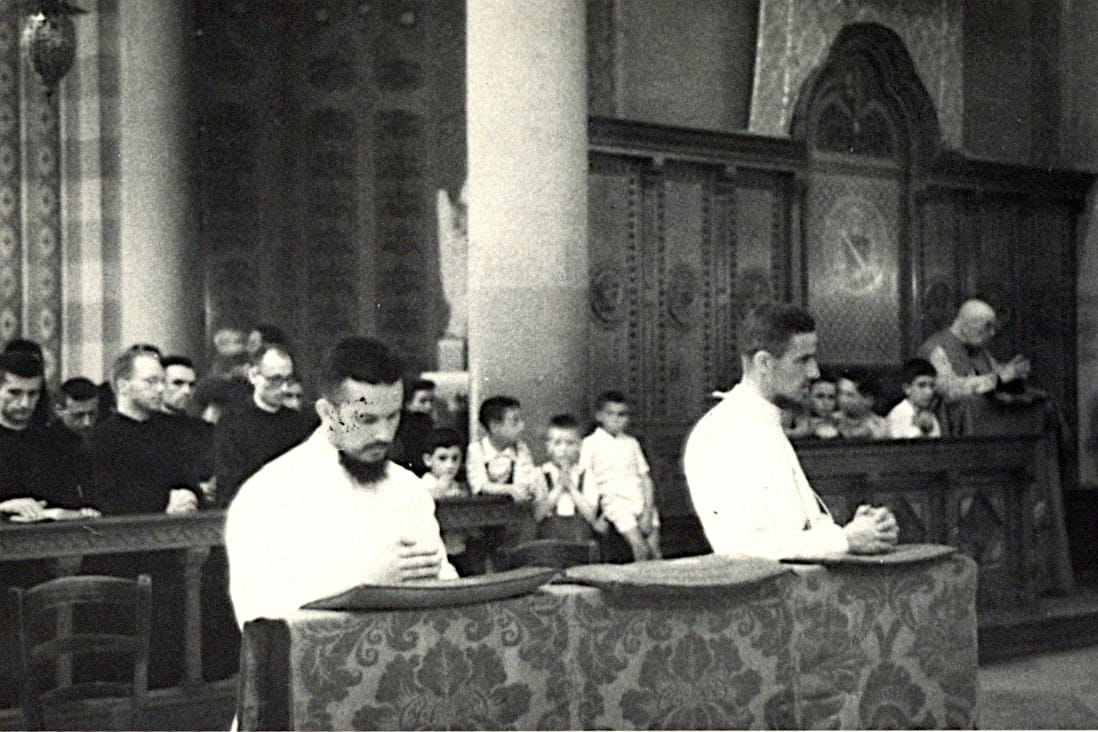
The departure of the Jesuits bound for the missions was a deeply moving occasion for both the religious community and the local people, who gathered to bid farewell to the departing Jesuits. Let us read together how the ceremony unfolded.
The source
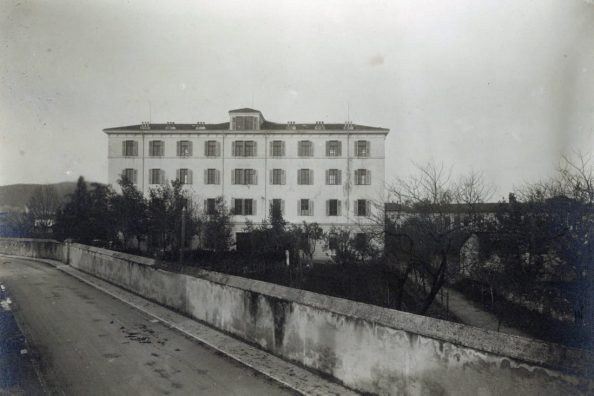
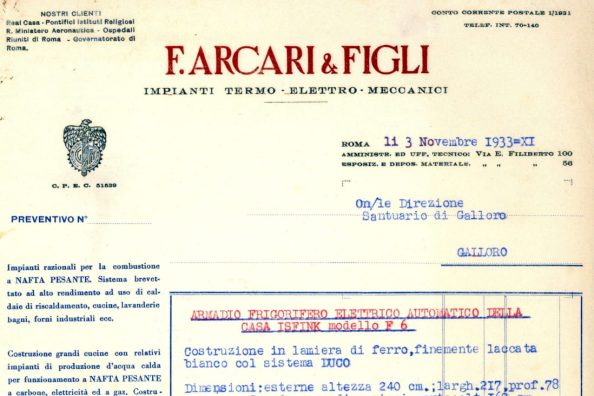
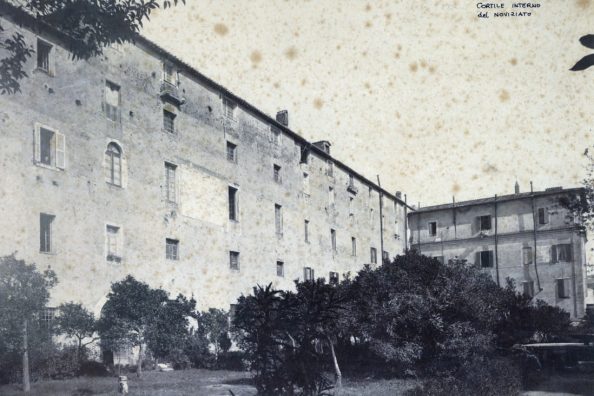
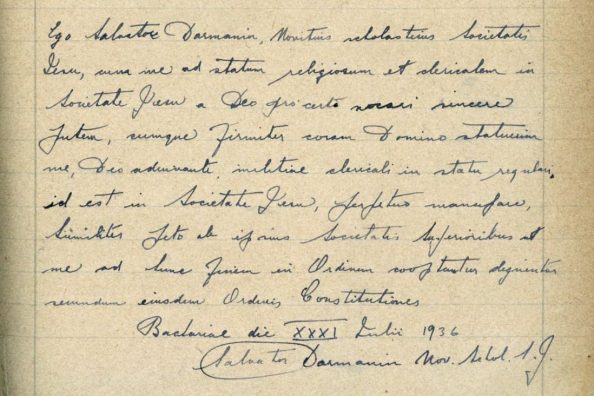
Today’s source is the house diary of the Lonigo community, which from 1933 to 1967 hosted the novitiate of the Veneto–Milan Province and from which several Jesuits set off for the missions. However, it is not the only one at our disposal. The ‘historia domus’ of the communities records the arrival or departure of Jesuits leaving the community for a new destination: for the missions or for another residence within the Province. Accounts of Jesuits setting off for the missions are in the house diaries of the novitiates and scholasticates of the other historic provinces.
There are also photographic records depicting the farewell ceremonies for the missionaries and the moment of their departure, preserved in the albums of the provinces’ photographic collections as well as in the personal files of the Jesuits.
If a researcher were to reconstruct the history of a missionary, they would have to start precisely with the personal file. However, it is important to remember that the missionaries’ papers are not kept solely in the historical archive of the province of origin but also in that of the destination, to which they were often transcribed or transferred. There is therefore a personal file held in the archives of both the missionary’s province of origin and his province of destination. Furthermore, the missionary’s personal papers – letters, homilies, notes, diaries – found in his room at the time of his death are sent to the historical archives of the province to which he now belongs.
Dreaming of the mission
Many aspiring Jesuits were already dreaming of the mission before entering the novitiate; they tell us this themselves when they fill in their entry forms for the novitiate. During the first probation or immediately afterwards, some wrote to the Provincial and then to the General to ask to be sent on mission. These are the so-called ‘Indipetae’: letters through which Jesuits ask Father General to be sent on mission.
Not everyone who expressed this desire saw it fulfilled, for various reasons. The Provincial would assess their suitability – both physical and spiritual – as life on a mission could be very harsh. At times, historical and political circumstances also prevented the request from being granted. As in the case of Fr Mario Delmirani, who repeatedly asked to go to China as a missionary; however, between 1947 and 1950, the clergy in China were persecuted and it would have been too dangerous to go. Furthermore, the Provincial and the Jesuits who assess the applications of those wishing to go on mission often note that these individuals possess a different charism, one that can be put to use in other apostolates: teaching, preaching within the province, or the management of charitable works. Consequently, whilst hundreds of applications were received by the Superior General each year, far fewer actually set off for the missions. They often began studying the language and culture of their destination well before departure, also learning English and French, which were often essential for communicating with the authorities and other religious orders already on the ground. Once the Father General had assigned them their destination, a farewell ceremony was organised before their departure.
From the Lonigo House Diary
Let us read together how the farewell day for some missionaries is described. It is 8 February 1948, and the Lonigo House Diary recounts:
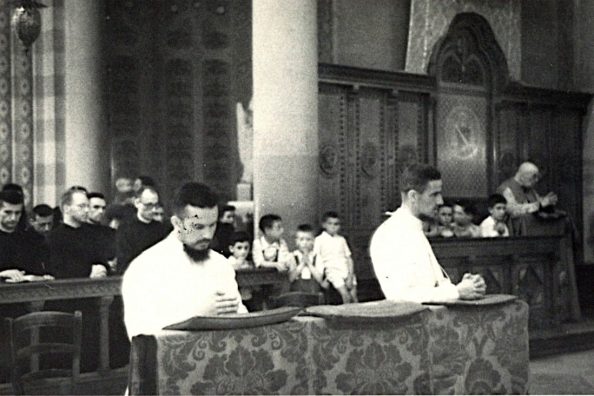
Mass sung by Fr. Zucol with a sermon by Fr. Springhetti in the presence of the other three departing missionaries: Fr. Leonardi, Br. Cantori, Br. Calligario Rubilio. Special lunch: starter, main course, dessert, wine, coffee. At 3.30 pm, service in the Cathedral: the community attends and takes part in Vespers. Then Monsignor ascends the pulpit with the new missionaries and Fr Springhetti. A few words from Fr Springhetti, followed by a speech from Monsignor, who presents each of them with a crucifix. After the Eucharistic blessing, a motet, the ‘Tantum Ergo’, and the ‘Missio’ hymn. After the congregation had kissed the crucifix, a photograph was taken of the community on the steps of the cathedral. Back at the house, a reception was held in honour of those setting off.
A couple of years later, on 11 June 1950, there was a new ceremony for the departing missionaries:
Feast of the two departing missionaries. They attended Mass at half past five, half past six and half past seven at S. Fermo and at nine o’clock in the Cathedral, where Fr. Silvio Springhetti spoke at all the Masses. Envelopes were distributed at the Masses and collected at the evening service in the Cathedral, held at 4 pm, which included: Vespers, a sermon by the Monsignor with the presentation of the crucifix, and a blessing by Fr Fernandez in English, translated by Springhetti. At the end, a photograph was taken on the steps of the Cathedral.
As we have read, the presentation of the crucifix is a very important symbolic moment, recalling the purpose of the missionaries’ lives but also the history of those who, before them, also met their martyrdom.
At the end of the ceremony, souvenir photos were taken; one of these is the one accompanying today’s episode. The caption reads: “Farewell to the heralds of Christ”.
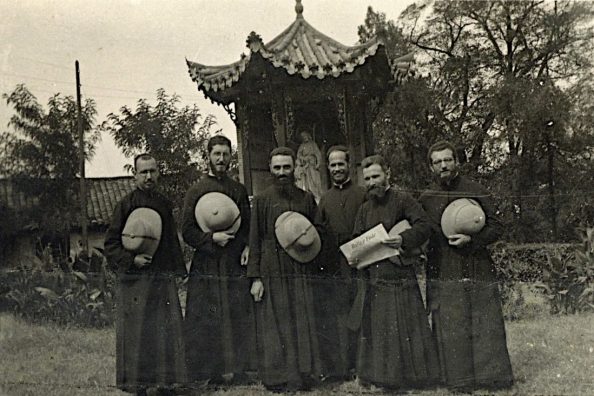
It is interesting to note that missionaries often no longer wear the priestly vestments like their fellow priests, but a different robe, the same one used in the mission territories. It is white for those living in hot areas to combat the heat, and sometimes orange, particularly in Africa. Often, when they set off, they already have long beards, both to blend in with the local culture and because missionaries wished to avoid cuts and infections that could result from shaving. Jesuits bound for China, in particular, always have long beards. Father Vincenzo Marchi, a missionary in China, was depicted wearing traditional Chinese attire. The journey to the mission could be very long and not without misadventures.
After departure
Most of the Jesuits who set out for the mission, especially between the nineteenth century and the early decades of the twentieth century never returned home. The missionaries’ lives continued, and they became members of the new provinces and vice-provinces formed from the missions, which gradually became independent from the ‘mother province’.
This does not, however, mean that contact with family, the province and fellow brothers was severed.
We have several accounts of this. Fr. Vincenzo Marchi, for example, who set off on 20 September 1870, arrived in China after a long journey. He would die there decades later, but in the meantime, he maintained contact with his family and the Province. We know many aspects of his life and his apostolate precisely from his own writings: he wrote dozens of letters, which are preserved in our historical archive.
Fr. Bortone, also a missionary in China, belonged to a later generation. He returned to Italy, where he continued his religious life. Whilst in China, he had kept in touch with his brother, who had also become a Jesuit; the latter preserved the letters by having them bound. Thanks to him, it is now possible to consult the correspondence from China.
Most of the missionaries wrote to the Provincial to inform him of their apostolate, the difficulties encountered or their needs. Researchers can read many of these letters, published in the Edifying letters. Here we also find the obituaries of the missionaries, which often recount their lives on mission.
The stories of the missionaries are also documented in the provincial magazines, and particularly in *Missioni*. The province maintained contact with the missionaries precisely through these magazines. Here, the religious often published announcements and appeals to collect alms or fund mission projects.
Finally, the Provinces maintain a strong link with the missions through Mission Days as well. On these occasions, the communities organised exhibitions, screenings, concerts and conferences to recount the work of the missionaries, including through artefacts from the missions (drawings, statues, stuffed animals, embroidered fabrics, photographs). In Lonigo, the Jesuits organised several missionary exhibitions.
The missionary’s departure therefore does not sever the ties that bind him to his family of origin and to his religious community.
Maria Macchi