Documentary types
In the past, each community drew up various documents to bear witness to the work of the fathers and brothers; some, such as the litterae annuae and the historiae domus, served to keep the General and the Provincial informed, whilst others, such as the community diary, remained in the community’s historical archive.
The historiae domus and litterae annuae are indispensable for reconstructing the history of the Jesuits and their residences.
Historia domus
The historia domus was a triennial report that succinctly recounted what had taken place in the community: the Jesuits’ apostolates, deaths, notable events, renovation work on the house and church, the number of communions and weddings, and information on charitable works. One copy was sent to the Father General, one to the Provincial, and one remained in the community’s archive. For this reason, it is now possible to find one copy in ARSI, the central archive of the Society of Jesus, one in the provincial historical archive, and one in the community’s archive. If the community has been closed, the provincial archive will contain two copies of the historia domus for that residence.
The historia domus was compiled on the basis of the littera annua, summarising the events recounted therein. This document was prepared by a Jesuit from the community, appointed by the superior – the same person who was responsible for the littera annua. Sometimes the Province’s historical catalogue indicates who was in charge, although this is not always the case. Throughout the nineteenth century and the first half of the twentieth century, the historia domus was written in Latin. In the case of Roman communities, which were more closely linked to the tradition of the Curia, examples of historiae domus written in Latin can still be found right up until the end of the twentieth century.
Littera annua
The littera annua was an annual written report serving the same purpose as the historia domus. It was intended to inform the recipient of what had taken place in the community over the past year: apostolic works, deaths of Jesuits, special ceremonies, extraordinary events and renovation works. The littera annua, however, was longer and more detailed than the historia domus. Historical catalogs often mention the Jesuit, appointed by the Provincial, who was tasked within the community with ‘Colligat puncta pro littera annua et historia domus’ – that is, with gathering information to write the littera annua and the historia domus – though he did not sign them.
Come per le historiae domus, oggi è possibile trovare più copie: una in ARSI, due nell’Archivio Storico di provinica. La littera annua era scritta a partire dal diario di casa. Anche questo documento è scritto in latino. Nel corso del Novecento le comunità hanno iniziato a inviare un unico documento, in forma ibrida: una historia domus annuale.
House diary
The house diary was a daily record of events in the community, kept by a Jesuit appointed by the superior. However, the author never signed the house diary, which is why it is very difficult today to ascertain who compiled it. Furthermore, a single diary could cover as many as ten years of history, meaning that several different people took turns writing it over time.
During his annual visit, the Provincial would ask to see the house diary and check that it was well maintained, issuing warnings in the event of omissions or neglect.
The house diary was a source that formed part of the community’s archive. It is transferred to the historical archive together with the collection of the residence or college when the residence is closed.
It was from the house diary that the littera annua could be drawn up, and from this the historia domus, precisely because the house diary provided an extremely detailed daily chronicle.
The style of the diary, however, depended greatly on the writer’s hand: some were particularly generous with information, whilst others were more sparing with details.
During the twentieth century, the communities gradually stopped writing two separate documents – the littera annua and the historia domus – and eventually began submitting a single document: an annual historia domus.
They continued to keep the household diary, which they then, unfortunately, began to neglect from the 1960s onwards, although many conscientious communities continued to maintain it right up until the 2000s.
Over the course of these decades, research into archival records has revealed a convergence between the historia domus and the household diary. The household diary is sometimes written in Latin and sometimes in Italian; in almost all residences active during the 20th century, it is found in Italian, or at least in the local vernacular.
Church diary
The church diary is very similar to the household diary, but was probably written by the rector pro tempore. It records the most important events: special liturgies, funerals or weddings, and provides information regarding the apostolate carried out in the church – catechism, specific works. It may sometimes contain details of renovations. Not all churches kept a diary, and in many cases, it has not been preserved.
Historical catalogue
Every province of the Society of Jesus still publishes its own catalogue annually. This is a list of all the residences and active works within the province, and of all the Jesuits who live and work there. The catalogue lists the apostolates and duties of both the fathers and the brothers. The catalogue is written in Latin and is printed, except for the early years of the Reconstruction and certain historical periods when manuscript copies were produced. The catalogues produced as part of the reconstruction project can be consulted online up to 1950 on the ARSI website. Our historical archive provides a glossary to help understand the abbreviations.
Status temporalis
This is a financial statement – a sort of ancient budget – which each community submitted to the Province, setting out income and expenditure, albeit not in great detail. It was sent every three years, but from the first half of the 20th century onwards, annual documents can also be found. The status temporalis was subsequently replaced by financial reports and the communities’ actual budgets from the 1970s and 1980s onwards.
Minutes of Provincial Consultations
Every month, the Provincial meets with his consultors – Jesuits who assist him in the governance of the Province – to discuss various matters: residences proposed for closure, works requiring approval, and the stages of the brothers’ formation. Minutes are drawn up for each consultation. The archives of each Province preserve the registers of consultations in which these minutes were recorded. They were written in Latin throughout the nineteenth century and the early decades of the twentieth century, and subsequently in Italian or the local language.
Minutes of House Consultations
In every residence there is a house council: the superior, the minister and a number of Jesuits – appointed by the Provincial – meet periodically to discuss matters relating to daily life: organising community life, making decisions on apostolates, work and expenditure. The minutes of these councils were written in Latin throughout the nineteenth century and, from the early twentieth century onwards, in Italian or the local language.
Community Customs
This is a collection of the rules and notices in force within the community; it is frequently found in novitiates, scholasticates and colleges. It provides guidelines for the practical life of the community, including menus, the timetable governing the day, and instructions for the brothers, the barber, the house librarian and the sacristan. They may be in Latin, Italian or the vernacular. They are often mimeographed or printed.
Reports on the canonical visit
Il Provinciale ogni anno compie una visita canonica a tutte le residenze della provincia, ha un colloquio personale con ogni gesuita, visita le opere. Al termine della visita scrive una relazione al Padre Generale, oggi conservata in ARSI (a volte la copia si trova nell’Archivio Storico della Provincia) e anche un memoriale della visita che invia al Superiore della comunità. In questo documento sottolinea aspetti positivi e negativi esortando la comunità a migliorare in alcuni punti. Il documento si trova nel fondo archivistico della comunità o nei faldoni delle residenze all’interno del fondo della Provincia, in Archivio Storico. Anche in questo caso il documento è scritto in latino per l’Ottocento ed i primi anni del Novecento poi in lingua vernacolare.
Registers of novices’ declarations
When a novice entered the novitiate, he had to complete a register, following a standard form, in which he recounted his life up to that point: the names and occupations of his parents, whether he had brothers or sisters, and whether they were young, married or members of a religious order. He described his upbringing and education, his vocation and the reason why he had chosen the Society of Jesus, and when he entered the novitiate. Each account was handwritten by the novice and signed. These registers were kept at the novitiate; today they are held in the archives of each of the five historic provinces. They are the only source that allows us to learn about the lives of Jesuits prior to their entry into the novitiate.
This practice is no longer in use at the novitiate of our province.
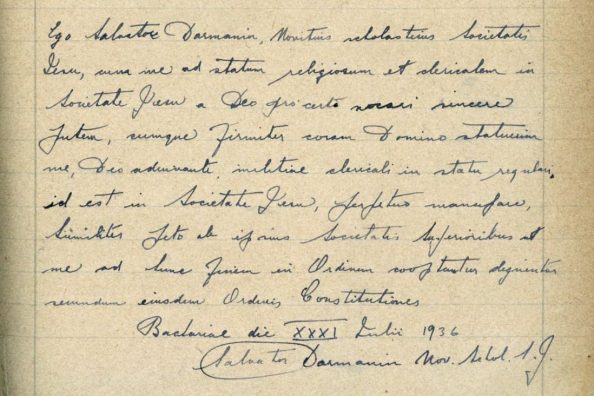
Registers of Vows
At the end of the two-year novitiate, novices take their First Vows; these were recorded in a register stating the place and date. There is also a register recording the place and date of the Final Vows. Registers of Admissions and Departures.
Registri di ammessi e dimessi
The names of the Jesuits are listed in the admission registers, to which the novice was added upon entering the novitiate; the records were then updated with the dates of their vows and their deaths. Jesuits who left the novitiate were recorded in a separate register, which lists the date of their departure.
Examination Registers
These registers contain assessments and marks for the course of study in philosophy and theology. They are held in the Province’s archives.
Obituaries
This type of document is not always present in the archives. For Jesuits who died from the late nineteenth century onwards, a printed obituary is often found in their personal file; these were also published in the ‘Lettere Edificanti’ or in the Province’s journals. For those who died earlier, handwritten obituaries are sometimes found in the provincial collections; however, for Jesuits who died in the first few decades following the reconstitution of the Society, we often do not have a proper obituary. For all of them, it is always possible to find a mention of their death in the *historia domus* of the residence where they passed away or to which they were attached. Occasionally, letters are preserved in which the superiors of the residence informed the Provincial of the death of fathers and brothers.
Personal file
There is a personal file for every Jesuit. The historical archive contains the files of those who died as Jesuits, in the ‘deceased’ series of each provincial archive; of those who left the Society, in the ‘resigned’ series of the provincial fonds; and of novitiate aspirants, in the ‘candidates not admitted’ series found in the provincial holdings.
The personal file contains the official documents relating to the individual’s religious life: certificates of Baptism and Confirmation, diplomas, occasionally school reports, the handwritten document of first vows and that of final vows, letters sent to the Provincial, and photographs. Occasionally, an obituary is also included.
However, the personal file is not an archival category that has always existed in the archives of the Society of Jesus. In fact, in the Old Society and also in the early decades of the New Society, documentation was organised into documentary series (the series of Baptism certificates, the series of First Vows, and so on), as demonstrated by certain reference marks found on the documents. The personal file, which emerged as an archival category during the Napoleonic period and became widespread in subsequent years, was subsequently adopted in the Society’s archives during the nineteenth century. To create these personal files, the previously existing documentary series were therefore broken up.
Personal papers such as notes, drafts, spiritual diaries and photo albums were sometimes included in the personal files; however, if the volume of material belonging to the deceased was substantial, it was placed in a separate series known as ‘personal writings’. Nevertheless, we do not possess this documentation for all deceased Jesuits. In the past, in fact, only the personal archives of Jesuits considered distinguished – because they were already famous at the time of their death – were often preserved. This criterion had a significant impact on the preservation of the personal papers of lesser-known Jesuits, and in particular of the coadjutor brothers.
As for those who had left the Society, the archive retains only the official documents; their personal papers are not held in the archive but must be sought in the family archives of the individual concerned.
Academies
These consist of pamphlets and booklets, mostly printed or mimeographed, produced for recitals. In the colleges, end-of-year recitals were held, or on the occasion of certain festivities. The pupils performed mainly in the recitation of poems – from which the name ‘academies’ derives – as well as in theatrical performances, songs, charades and demonstrations related to the subjects studied.
On these occasions, at the end of the school year, the school’s top pupils were awarded prizes. A list of the school’s pupils was then published, along with the names of those who had won prizes in various fields (by subject, for good behaviour, or for religious devotion). Alongside the academies, we should also mention the regulations of the boarding schools, which were often printed. These are document types typical of colleges.
Admonitions
Although this is not a document type in the strict sense, we mention it because one may come across such documents in historical archives. When the Provincial visited a community, he might issue admonitions on the spot. These are observations regarding matters he had noted during the visit and which he preferred not to include in his official report. These recommendations may include calls to observe the rule, to foster a greater spirit of brotherhood, or, at times, more practical advice on keeping the premises clean or on the need for better organisation of community life.
Edifying letters
Edifying letters constitute a distinct literary genre: these are letters addressed to the Provincial by missionaries and Jesuits from the Province. Each Province published an annual collection of selected letters; however, as they were not published in full, we advise researchers to consult the originals in any case. Our historical archive holds the edifying letters from the five historic Italian Provinces: Veneto-Milanese, Turinese, Roman, Neapolitan and Sicilian.
he genre of edifying letters, at least in Italy, fell out of favour from around the 1920s onwards, when the provinces began publishing their own magazines such as “Notizie” or “Agli amici” and, above all, with the launch in 1915 of a periodical entirely dedicated to the missions, bearing the same title: “Le missioni”, which later became “Popoli e missioni” and subsequently “Popoli”, before ceasing publication in 2012.
The edifying letters contain not only letters from missionaries but also from Jesuits living in the province, as well as obituaries of fathers and brothers who passed away each year. Once the publication of the edifying letters ceased, the obituaries were subsequently published in the provincial journals.
Documentary types not typical of the Society
Parish registers (Baptism, Confirmation, Marriage, Burial, registers animarum)
Although every church kept these registers, in which the principal sacraments of the faithful were recorded, along with the annual census – as regards the registers of souls – this material is not held in our historical archive. In fact, the sacramental registers are deposited in the diocesan historical archive of the diocese to which each church belongs.
Visitae ad limina
These are the reports written by each bishop at the end of his triennial visit to his entire diocese (the term ‘ad limina’ means ‘visit to the territory’) and subsequently sent to the Holy See. Today, one copy is held in the Vatican Apostolic Archives and another in the local diocesan historical archive.
Featured documents
Relics, personal belongings, distinguished alumni, memories of other historical periods: a selection of interesting documents from our Archives.