The parents of Jesuits
Is it possible to hear the voices of the parents of Jesuits? What did they think of their children’s choice? What documents could allow us to find out?
The papers kept in the Jesuits’ personal files bear witness to the various stages of religious life: baptism and confirmation certificates, information provided by Jesuits who met the novice, first vows and final vows, certificates, diplomas. We might think that all that remains of the parents is a first name and surname in the early documents.
Documents signed by parents
However, our archives contain much more than that. For example, we have permission to enter the novitiate signed by both parents. Often, on this occasion, the mother signs with her maiden name. This was a mandatory document until the early decades of the 20th century. Some researchers have noted that the novitiate’s household diaries sometimes contain traces of discontent on the part of some fathers, often nobles, who did not agree with their son’s choice to embrace religious life. This is the case of Monaldo Leopardi, who was loudly protested by his father.
We also keep some letters addressed by parents to their novice son and then included in his personal file, or by the mother of a Jesuit to the Provincial.
The faces of mothers, fathers, brothers, sisters and relatives populate many of our photographs: they are present at their son’s first Mass, at his Final Vows, sometimes invited to the community for celebrations or pilgrims themselves, together with parishioners. In the personal albums of many Jesuits, there is a photo of the parents kneeling in front of their son as he receives the host during his first Mass: a moment certainly very emotional. Family relationships are widely documented: in the papers of the deceased, there are funeral memories of various family members, photos of the Jesuit as a child in his parents’ arms. Often the Jesuit celebrates the marriage of brothers and sisters. Sometimes there are also a few letters from his family.
A notebook of memories
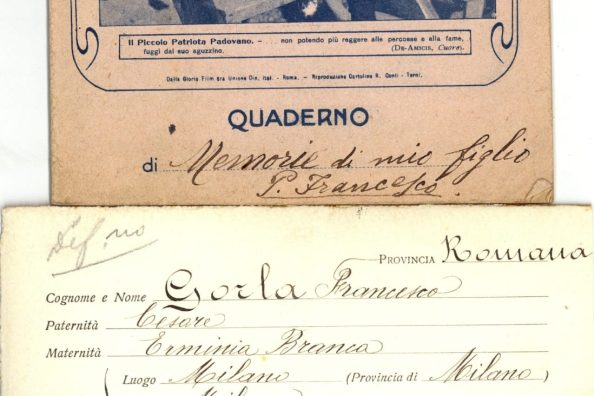
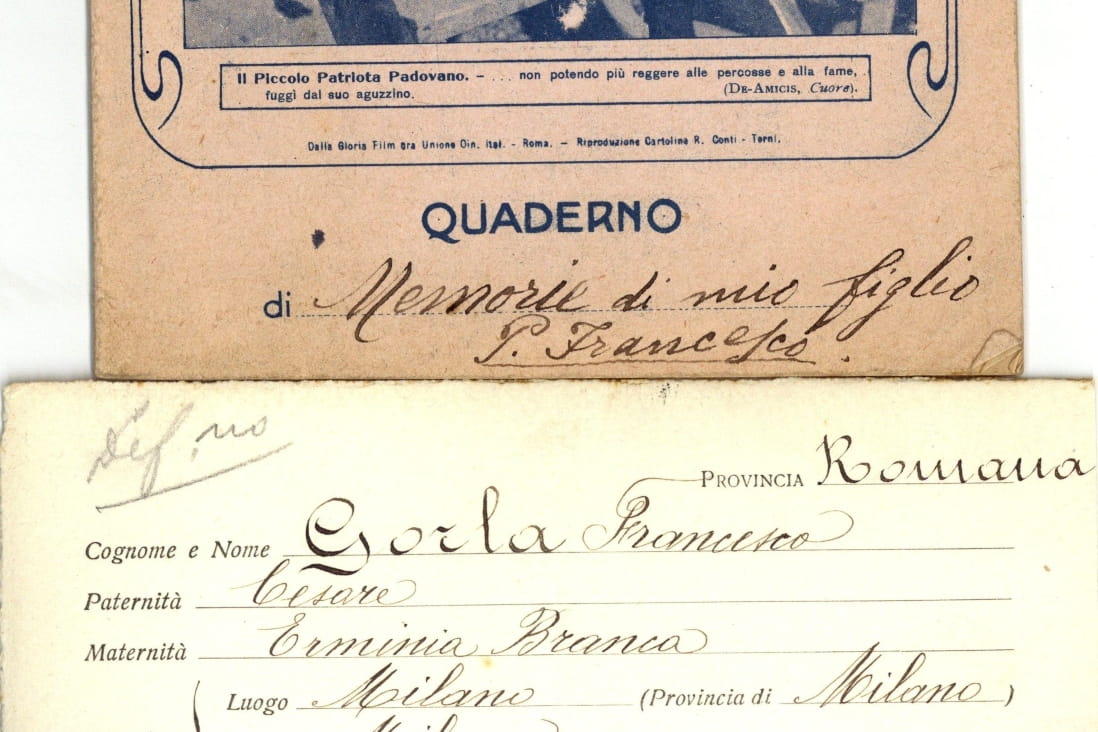
Today, however, we are talking about a document that is difficult to find in the archives. It is a small notebook found in the personal file of Fr Francesco Gorla. It is not his diary, nor does it contain his spiritual notes: it contains the memories of his mother, who signs herself Erminia Gorla on the last page.
Encouraged by her brother-in-law, a monsignor, who advised her to take notes on her son’s life, she wrote: ‘Not to boast about his qualities, much less to receive praise myself, but to give glory to God and to show him my gratitude.’
Father Francesco was born on 24 February 1894, he joined the Society on 12 November 1920 and he died on 11 November 1939 at the age of 45. His mother refers to him in the past tense throughout her account. She probably wrote it shortly after her son’s death, although the notebook is not dated.
From the pen of Erminia Gorla
Here are some particularly touching passages from Erminia Gorla’s account of her son:
When I think of so many details of my son’s life, I am convinced that his vocation was, I would say, almost born with him. […] One morning we took him to attend the memorial Mass for my poor father: after the Mass there were some services, we stayed, about two hours passed without us noticing, it was therefore well past lunchtime, the child did not utter a word, attentive to the whole religious service.
When we left, a woman told us that she was amazed to see such a small child sitting still and attentive in church for hours. I think it was on that occasion that he said to me, “I would like to become Pope so that I can know everything about religion”. […] We moved to Genoa when he was eleven: at that time, there were many immigrants and beggars in the city; he felt particularly sorry for the immigrants, sitting on the ground, battered and tired, and he always asked me for money to give them. Since I told him I did not have much money, he changed tactics and said, ‘Look, Mum, that poor woman (or that poor man) must be feeling ill, don’t you think?
[…] in February 1915, my brother died, and I fell ill with grief and a few minor ailments and had to stay in bed for about a week […] my son assisted me with all his affection, both morally and materially; he also cooked and tried everything he could to keep my spirits up. He often sat at the piano and imitated one of his very good friends who came over with his violin, and so they improvised little concerts to distract me, knowing that I love music very much. […] In addition, here I will talk about his vocation, which he announced to us after returning from prison: I must confess that this announcement came as a shock to us. We could not persuade ourselves that our only son, who was so good and had returned to us safe and sound after more than three years of danger, should leave us alone […] With time and God’s help, we became increasingly convinced that by opposing him we were doing him harm. We only asked him to graduate before entering the Society: and although he would have liked to enter immediately, he gave in to our wishes […]. The time came for him to enter the novitiate: we accompanied him in the evening and left him there […]. Once he entered the novitiate, he was happy: we always received praise from the Reverend Fathers Superiors, both during his novitiate and when he was a scholar and finally as a priest. God bless him!
Letters from captivity
In addition to this small notebook, which tells us about the Jesuit’s childhood and the great affection between mother and son, the file also contains letters that Francesco Gorla, a young soldier during the First World War, wrote to his family before becoming a Jesuit. He was taken prisoner in Mauthausen and from there he sent several letters to his family. He wrote on scraps of paper, sometimes in pencil, reassuring his relatives about his condition. We will certainly devote another in-depth study to this part of Fr Gorla’s life and to the letters from the front that our archives preserve.
We wanted to dedicate the episode on 1st November – usually linked to the theme of the deceased – to this touching story. It testifies to how the memory of those who are no longer with us remains in the memory of the living and then passes on to paper and photographs, destined to be kept in historical archives, where, after some time, researchers reconstruct entire lives.
Maria Macchi