The Jesuits between the Unification of Italy and the Lateran Pacts
What happened to the Italian Jesuits between 1861 and 1929? These decades started with the rift between State and Church, which began with the Unification of Italy and the expropriation of religious orders’ assets and was “aggravated” by the fall of the Papal States on 20 September 1870. The Lateran Pacts signed on 11 February 1929 healed it. How did Italian Jesuits live during these 68 years? What did the unification of Italy mean for them?
From 1861 to the 1880s
These years are difficult to reconstruct, especially those between 1861 and 1880, as the Kingdom of Italy confiscated the properties of residences and colleges, forcing religious men and women, not only Jesuits, to leave their homes and cities. The Italian state infrastructure existed, in the first instance, thanks to the assets taken from male and female religious orders: dozens of former convents, monasteries and religious residences became hospitals, universities, schools, courts and barracks.
The Jesuits’ life continued, albeit with various difficulties. They had to cope with the loss of all their properties, churches and possessions. In many cases, they left their residences during the 1830s, in 1848 or in the years immediately preceding 1861. Neighbouring communities had often given shelter to the brothers. After 1861, however, the situation was very different. There were no longer any communities for Jesuits, in the provinces. What happened to dozens of religious figures? In some cases, the Italian State immediately expropriated the properties, while in others, the fathers and brothers had time to empty their homes and find refuge elsewhere.
Foreign provinces welcomed some, but many turned to the Roman province, the only one on the peninsula that still owned most of its properties, in Rome and the surrounding areas. Researching individual Jesuits, we discovered that during the years of dispersion, they lived in dioceses and in the homes of faithful believers, who thus made up for the lack of proper residences.
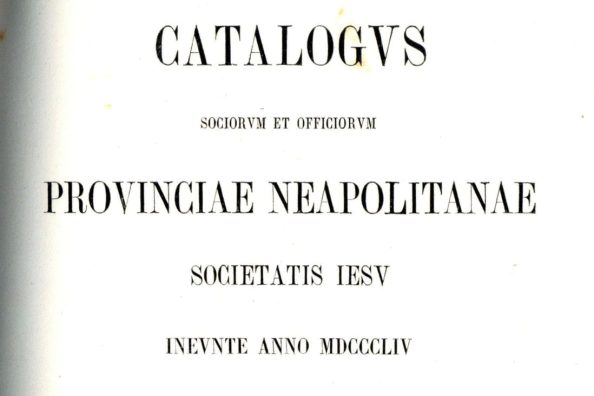
To learn about the situation of the Italian provinces, excluding the Roman province, which continued its activities until 1870, we can review the annual historical catalogues. We will find them much more concise and summary than the previous ones; for some years, they were not even printed. We must focus our attention on the section “Degentes extra domos”. Here, in fact, are listed all the Jesuits who lived outside the canonical residences. The section “Degentes extra provinciam” also tells us where the fathers and brothers lived.
There is another piece of information in the historical catalogues that provides us with useful information about the Jesuits in those years: the place of publication. In many cases, in fact, the catalogue was no longer published.
Turinese Province
The geographical proximity to France was salvific: many Jesuits headed for Nice and Bastia, in Corsica. It was in France, first in Marseille and then in Nice, that the catalogue of the Province of Turin was printed for several years. The latter could also count on the community of the Principality of Monaco, which was located across the Italian border but within easy reach. The Turin Province catalogue was printed in the Principality of Monaco from the mid-1870s until the late 1800s, when it returned to being printed in Turin. In the section on “degentes extra domos”, several Jesuits appear in Emilia and Tuscany, in the Roman Province, while others are found in Liguria – in Sanremo, in the sanctuary of Montallegro, in Genoa – and those who lived in Sardinia took refuge in Gavoi, Sassari and Cagliari. Numerous Jesuits moved to neighbouring French provinces and to Rome. Some, however, lived in the seminary in Cuneo and managed to remain in the Turin area.
The situation remained unchanged in the missions of the Province – in California and the Rocky Mountains – as they were located in other national states and were not affected by the political situation in Italy. This was true for all mission territories, which, not being part of the Italian state, were not, affected.
Veneto-Milanese Province
Although the Veneto-Milanese Province kept some communities open for a few more years, after 1861 it sent several Jesuits to those located across the border: to Ragusa and Zara, which were under Austrian rule at the time, or to houses in Albania. Some found refuge in Tyrol, in Eppan, not far from Bolzano (today Appiano sulla strada del vino). It was in Bolzano that the Province’s catalogue began to be published between 1867 and 1872, after which it was published in Scutari, where the Society of Jesus had its own printing press, which also published magazines in Albanian. It continued to be published there until the mid-1910s. Before publication was brought back to the Province in Venice in the early 1920s, it was printed in Mangalore, India, during the First World War.
Neapolitan Province
The Neapolitan Province found immediate accommodation in the professed house of the Gesù in Rome, where the provincial moved, as evidenced by the 1863 catalogue. Several fathers and brothers settled in the residences of the Roman Province and in towns not far from Rome: Terracina, Bauco (now Boville Ernica), Tivoli, Giuliano di Roma, Anagni, and Civitavecchia. Other Jesuits took refuge in Spain and in other provinces that historically had ties with Naples. The catalogue was printed in Rome between 1862 and 1870. After the fall of the Papal States, however, the Jesuits turned to a printing house in Caserta and from 1878 onwards, it was published again in Naples.
Sicilian Province
Most Sicilian Jesuits found refuge mainly in Malta and Gozo: they were an integral part of the province but constituted a separate state with a strong Catholic influence, and were therefore a safe haven. The catalogue of the Sicilian Province was printed in Malta during the early years of dispersion, then in Naples, and from the 1880s onwards in Palermo again. In this case, too, many Jesuits moved to Spain and other provinces, as well as to residences in Constantinople and Tyre and Syros, two Greek islands that were part of Sicilian territory.
The lack of sources
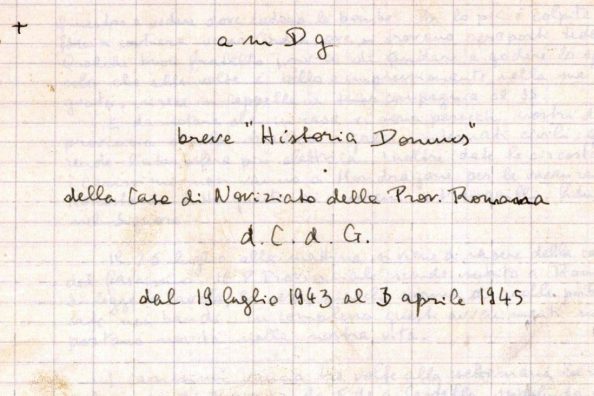
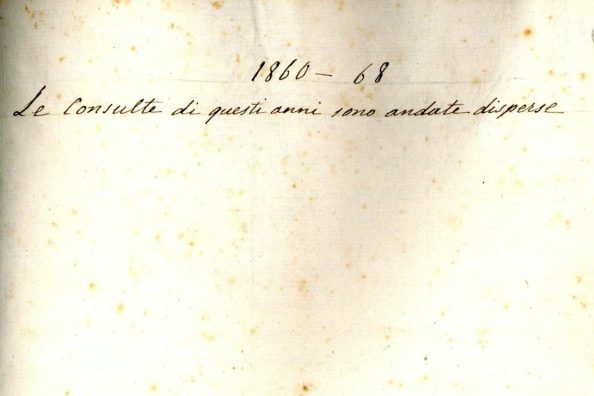
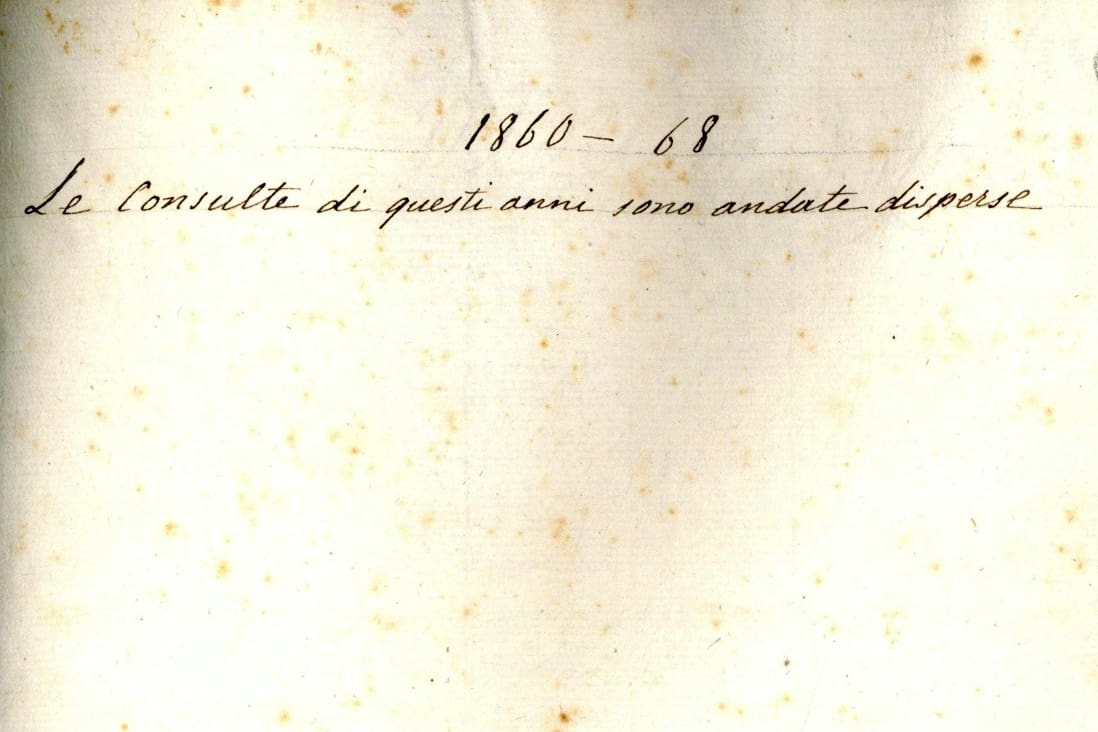
Without stability or a community of reference for a long period, documentary production often ceased. Although the Father General continued to be informed, correspondence was no longer sent periodically, and the Provincial’s canonical visits had decreased significantly because the confreres were scattered and there were no communities to visit. Therefore, for these years, the house diaries are missing, the historiae domus often have gaps, and even the provincial councils become less frequent. The photo accompanying today’s episode depicts a note in the records of the province of Naples, which are incomplete for the years 1861 to 1868. From the unification of Italy onwards, for at least ten, fifteen and sometimes even twenty years, it is very difficult to shed light on the lives of individual Jesuits, for whom we have some information from historical catalogues but a great lack of documentation in personal files and residence records.
The hardest years are precisely those from 1861 to the 1870s, a period in which we speak of “dispersed” provinces and residences, as they are also referred to in the catalogues. We are faced with significant gaps, sometimes only brief memories survive.
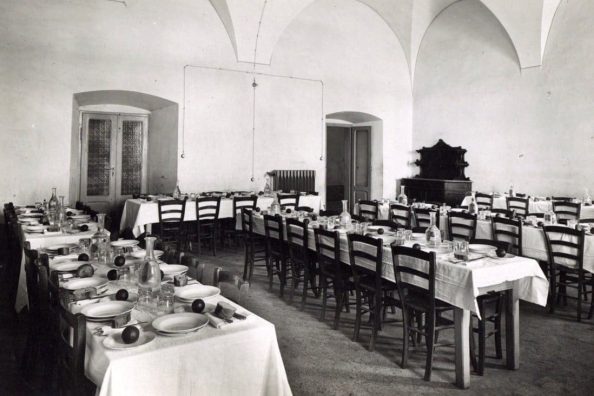
Then, slowly, the provinces began to rebuild themselves, thanks mainly to donations from the faithful. In fact, many of the properties still owned today date back to this period. Families of former students or benefactors donated properties to the Jesuits so that they could re-establish their community or their works, such as schools. In Naples, the Melecrinis family, from which Fr Melecrinis came, donated their villa in Vomero, which became the novitiate for several decades. In Livorno, the Pate counts donated the property that was to house the future St Francis Xavier Institute.
The birth of the Massimiliano Massimo Institute is also linked to what happened after 1870. Father Massimiliano Massimo made a family property, Villa Peretti, available to open the school, since the Roman Province had lost the Roman College, as well as numerous colleges in Lazio.
However, the donation of real estate was a crucial issue at that time. In fact, it was not so easy for the provinces to acquire new properties and manage them themselves.
Ownership of property before the Lateran Pacts
The unification of Italy had liquidated the ecclesiastical axis through expropriations, but the legislation in force since 1861 severely restricted ownership by ecclesiastical bodies, leaving only what remained within the Vatican walls intact. Ecclesiastical bodies could not be registered as owners of property, so the Italian Jesuits adopted many expedients to deal with this problem.
In many cases, former pupils to whom the property could be registered set up bodies. This was the case of the Società S. Brigida in Brescia, whose founders included the lawyer Lodovico Montini, brother of the future Paul VI, both former pupils of the Jesuits. Lay people and benefactors acted as figureheads in order to guarantee the existence of a legally registered civil institution to which the movable and immovable property of the province could be registered. In other cases, the property was jointly registered to several people, often relatives of the Jesuits. Sometimes property was registered to individual Jesuits but as “private” citizens.
However, these were temporary and precarious solutions, which, in many cases, required continuous sales to avoid the possibility that the owners would die and the inheritance would go to the heirs designated by law and not to the Society. Only after the Lateran Pacts was it possible to draw up new notarial deeds to transfer ownership of the properties to the various provinces and institutions to which they belonged.
With the Lateran Pacts, the Jesuits were once again entrusted with the churches to officiate, but ownership had definitively passed to the State and never returned to the religious orders. The FEC the fund for religious buildings, which is part of the Ministry of the Interior, now, managed most of the churches. The FEC also has its own historical archive, which we recommend consulting to shed light on the confiscation of property and churches after 1861.
The Roman case
The case of the Roman Province is different from that of the other provinces because of the different periodisation. The Society of Jesus retained ownership of colleges and residences in Rome and in what remained of the Papal States until 1870, nine years longer than the rest of Italy, which was unified in 1861. The Roman Province did not lose its properties immediately; the Jesuits of S. Andrea al Quirinale were given a year to empty the building and send the novices away, and they left the novitiate in December 1871.
The Roman College remained active for another couple of years, and the building was officially handed over to the State in 1873.
When the Roman Province lost all its properties, it was able to count on the other neighbouring provinces, which had reorganised themselves in the meantime. For this reason, Roman novices such as Fr Lorenzo Rocci and Fr Tacchi Venturi entered the novitiate in Naples, at Villa Melecrinis, as there had been no active novitiate in Rome since 1870. The Roman Province managed to reorganise itself during the 1880s and 1890s, reopening its own novitiate in Castel Gandolfo in 1882.
While Rome fell under cannon fire, a young Jesuit left for a mission in China, proving that life goes on and great stories can begin even in dramatic times.
Over the next ten years, the Jesuits of the Roman Province found themselves in different parts of Italy. The novices who were at S. Andrea al Quirinale were sent to Eppan, in Trentino, which at the time was not yet part of the Italian state. Fathers and brothers sometimes lived in private homes, as was the case in Ferentino, or scattered throughout Lazio: in the dioceses of Albano and Sutri, in Manziana, Civitavecchia, Tivoli, Castel Gandolfo, Viterbo and Poggio Mirteto. Many Jesuits moved to Tuscany, to Lucca, Siena and Pistoia, others to Emilia Romagna, to Bologna, Ferrara, Forlì and Imola; others to Umbria, to Spoleto, Orvieto and Gubbio. The catalogue was always printed in Rome, even in the years immediately following 1870. One of the most interesting aspects of the Roman case is the presence of temporary residences in the city, regularly reported in the catalogues and inventory of the collection. Unlike other provinces where for decades the Jesuits were unable to re-establish themselves in the main cities, in Rome the Jesuits opened temporary residences or relied on existing religious institutions to continue their apostolate. In the catalogues, these residences are indicated with Roman numerals, which, however, over time have distinguished different places. From the inventory, we know that they were located at: Via della Valle 41, S. Brigida, S. Caterina in Via Giulia, Palazzo Vitelleschi – of which Fr. Vitelleschi, later rector of the Collegio dei Nobili di Villa Mondragone, was a member – and the residence of Cecchina.
Colleges and ecclesiastical institutes hosted several fathers and brothers: in the Capranica college, in the Belgian College, in the house of the catechumens, in S. Luigi dei Francesi, and in Villa Torlonia.
A case study
The question of property ownership concerned every residence or work of the historic Italian provinces. Therefore, for each purchase or donation, there is usually documentation that tells us about its vicissitudes.
In addition to the S. Brigida Society of Brescia, there is one case in particular that we would like to focus on, which clearly illustrates the numerous changes in property ownership during this period.
The issue of ownership also affected Fr. Strickland who on 20 October 1906 purchased the recreation centre property in the “Le Cure” area of Florence. Although he was Maltese, he was not exempt from the regulations in force in Italy at the time and therefore found himself in the position of having to resolve the issue in order to have a place to house his work. Four years later, he sold it to Baroness Treves, who two weeks later transferred it in emphyteusis to Fr Cesare Goretti Miniati, a confrere of Fr Strickland. On 14 April 1931, the baroness sold the bare ownership to Bur, and the following year Bur acquired full ownership following legal proceedings. BUR then donated the property to the Roman Province on 23 June 1937.
The recreation centre thus passed from hand to hand but remained under Jesuit management until it could legitimately return to the Roman Province, continuing its activities until the early 1960s.
The cases illustrated so far show us that the expedients found by the Society were not attributable to mere possession or speculation: the properties were necessary for the apostolate, to provide a home for fathers and brothers, to remain and work in the territories of the provinces.
Father Strickland literally took dozens of children off the streets by teaching them a trade, and his work continued for decades; Villa Melecrinis provided generations of Jesuits with training, education and a place to live; the Massimo Institute educated generations of students.
Provinces maintained many of the properties – donated between 1861 and 1929 – for decades, as house residences, schools and works, mindful of the generosity of so many benefactors.
How to reconstruct this period
As already mentioned, the documentary production was greatly affected by what happened in 1861 and 1870 for the Roman Province.
We often have no documentation for the years between 1861 and 1880, but it is always important to read the first historiae domus written by the residences as they gradually reopened their doors, as in many cases they contain memories of previous years. Sometimes, in their first letters to the Provincial, the Superiors and Rectors recount how the Jesuits lived through that period, how they managed to return to the city, and who helped them. Often, the Provincial, in turn, informed the General about what had happened in certain territories during the dispersion.
The deeds of sale and the records relating to the various transfers of ownership are often in the fund of Province’s treasurer office. As in the case of the Ricreatorio in Via Cirillo in Florence. It is therefore essential to check the bursar’s records.
Anyone wishing to reconstruct the history of the residences between 1861 and 1929 or the life of the Jesuits during this period must take into account the lack of sources and gaps, but also the complexity of property management until 1929.
Maria Macchi