Fr. Darmanin: prisoner in concentration camps
The story of Fr. Darmanin is one that emerged from our archives after the opening of the pontificate of Pius XII, requested by Pope Francis. It was reconstructed by one of our researchers, Laura di Fabio, in a recently published book.
A little-known story in the Province
Among the papers of the Veneto-Milanese Province survives a part of the personal story of Fr. Salvino Darmanin, little known to his Maltese confreres and completely unknown to the rest of the EUM Jesuits.
During the Second World War, Salvino Darmanin was not yet a “father”; he was in fact a Jesuit in training and would only be ordained a priest later, in 1949.
He was born on 31 October 1919 and entered the Society of Jesus on 1 November 1934 at the novitiate in Bagheria, at Villa S. Cataldo, in the Sicilian Province. Like all his Maltese confreres at the time, he had to go to Sicily for his novitiate, as it no longer existed in Malta. The island was part of the Sicilian Province, whereas previously, for several decades in the 19th century, it had belonged to the English Province.
Fr Darmanin in Italy
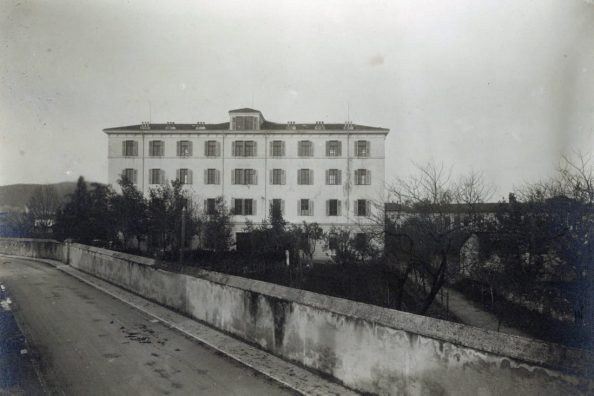
When the Second World War broke out in September 1939, the scholastic Darmanin was engaged in the carissimato in Bagheria, at the end of which he was assigned to the Aloisianum in Gallarate for the first year of his studies in philosophy. He arrived in the community on 6 August 1940, two months after Italy entered the war. The diary already records air raids and alarms, curfews and the obligation to black out windows at night. The following year, in the middle of winter, it is still not possible to turn on the heating due to a lack of coal.
We also know that Fr Meylak, another Maltese, had to report to the police headquarters in Varese upon his arrival in Gallarate. On 16 August, the police commissioner informed the Superior of the Aloisianum that the Maltese were “interned”: they could not leave the municipality of Gallarate without notifying the police headquarters. The Greek scholastics, who were in Lonigo at the time and were also defined as ‘interned’, suffered the same fate. Daily life consisted of study, services, recreation and meals. There were other signs of the war, apart from the bombings: sweets were not distributed, and no dessert was served at the end of meals ‘because we are at war’.
When the scholastics of Gallarate left for a holiday in Bormio – where the Society of Jesus had a holiday home at the time – Darmanin was unable to go, and with him the other Maltese scholastics, the only Albanian, two Slovaks and a Lithuanian remained in Gallarate. During that period, he taught catechism in Ronchi, a town in Gallarate, together with another scholastic. Permission was then granted by the police headquarters for those who had been excluded, but the Maltese were not included and settled for a trip to Porto Ceresio. Together with the other Maltese, he also went on another trip, considered a day of “villa”, i.e. rest, on 13 August 1941 to Sesto Calende.
On 24 February 1942, the Minister accompanied Darmanin on a visit, the outcome of which required him to “immediately consider a sanatorium”. On 11 March, the Minister went to Arco to arrange for Darmanin’s admission to the Sanitario di S. Pancrazio hospital. He also contacted the nuns who ran the sanatorium to find a place for the schoolboy. Darmanin left for Arco on 1 April, again accompanied by the Minister. While in Arco, he received a visit from the Rector at the end of June and from the Minister at the beginning of July. Meanwhile, the bombings raged on, hitting Leone XIII and then Arici in Brescia. Darmanin received another visit at the end of August. Although his name is not mentioned in the house diary, we know that a Jesuit brother from Gallarate was taken to Arco, to the same facility where the Maltese scholastic was staying.
The arrest
It is 1 October 1942: in Gallarate, the Jesuits receive news of the arrest of the scholastic Darmanin. The initial information is confusing: the diary reports that he has disappeared and that he was travelling to Gallarate when someone kidnapped him in Milan.
We then discover from other attached documents that Darmanin had to leave the sanatorium on 30 September because the building was occupied by Nazi troops. The Jesuits are told that the scholastic went to the German command to obtain a pass to Gallarate. This mistake, made in good faith, would cost him dearly. He was taken to Milan, to the SS headquarters, and imprisoned in S. Vittore, in the prison infirmary. The same place where, three months later, little Liliana Segre and her father would also be taken. The S. Vittore prison was often the preliminary stop for Jews and political prisoners before their departure for the extermination camps.
Darmanin’s arrest did not take place because he left Gallarate despite the ban we mentioned earlier. In fact, he had been living in Arco for a year and a half and was a regular resident.
Until his hospitalisation, Darmanin had also been able to take part in trips, but always to places within the province of Varese. He did not go to Bormio, in Trentino Alto Adige. The Gallarate diary also reports that two other Maltese scholastics, Vella and Caruana, arrived in Gallarate on 21 October 1942 “accompanied by a police officer”, who seems to have simply escorted them. However, all this took place before 8 September 1943, the date of the armistice, after which Italy was occupied by German troops.
Darmanin was Maltese, a foreign citizen from a country that was an enemy of the Germans, which is why he was arrested.
A long imprisonment
We do not know much about his imprisonment; the only documents we have to go on are the occasional communications he managed to send.
Meanwhile, however, the Jesuits did not stand idly by. Father Lorenzi immediately left for Milan to obtain information about Darmanin and find out how to secure his release. He went to the SS headquarters but was told nothing. The Jesuits sought information through the Viscount of Mondrone, president of the Red Cross, and also approached the Vicar General in Rome and the Cardinal of Milan.
His confreres did not yet know it, but Darmanin had been put on a train and sent to Mantua.
Meanwhile, Fr Lorenzi went to the nuns of Besozzo who worked at the sanatorium in Arco, then to Luino to meet another German soldier, before returning to Milan and asking for information from the headquarters of the Fascist Republican Party and the Consul General in Switzerland. A request also arrives from Arco, directly from the Command in Milan, asking for information on the Jesuit’s whereabouts.
Meanwhile, Darmanin has arrived in Mantua and manages to write a short message, which, however, will only reach Gallarate on 18 October:
Mantua, 15 October 1943
Reverend Father, I am currently in Mantua. I am doing quite well. I would like to ask you to send me my suitcases as soon as you can. I have nothing with me, nor do I know if I will always be here. Please give my regards to my fellow philosophers and recommend me to their prayers. Your humble servant in Christ, Salvino Darmanin.
The Jesuits acted immediately and Father Lorenzi travelled as far as Mantua, but it was too late: Darmanin was already on a train bound for an unknown destination. Here, however, his confrere learned that he was doing quite well, ‘eating ordinary food, cleaning his mess tin and keeping company with several English prisoners’.
Meanwhile, a second note arrived in Gallarate:
Mantua, 16 October 1943
Reverend Father Rector, this morning I am leaving for a new destination. Please suspend the sending of laundry for the time being. I return to commend myself to the prayers of the community. In Christ’s service,
Salvino Darmanin
This is the last communication that the Jesuit manages to send from Italy. The Jesuits were only informed on 21 October that on the 16th of that month Darmanin had been put on a cattle truck and left for an unknown destination. The Jesuits then received another message in early 1944, of which we have indirect evidence in a letter written by the Rector of the Gregorian University to the Rector of Gallarate:
Rome, 11 January 1944
Reverend Father Rector, Pax Christi
I have received a postcard from Brother Darmanin in which he writes, “I am still well in many respects; my health is also good”. He gives me his address: Salvino Darmanin N + I38747 Stalag XI A, Germany, and asks me to remember him to Your Reverence, which I am happy to do in this letter.
The Jesuits of Gallarate would hear nothing more about Darmanin until the war was over.
A note in the 1945 catalogue of the Sicilian Province (remember that the schoolmaster was a Jesuit from this Province) states: since we do not know where he is, we are writing this here.
Meanwhile, life also became more difficult for the community in Gallarate: the house was occupied by German troops and long months of difficult coexistence began, as we can read in Laura Di Fabio’s book.
The life of Fr. Darmanin
Fr. Darmanin was freed after the end of the war and returned to Malta.
After his dramatic experience in the prison camps, he resumed his studies and had a long religious life, with various assignments for which he is still remembered today by his confreres. He completed the philosophy course, interrupted in Gallarate, at Heythrop, England, while he studied theology in America. He was ordained a priest on 14 June 1949 while studying theology. He returned to Malta in 1951 to teach at St Aloysius College in Birkirkara, where he became rector twice, from 1953 to 1959 and from 1968 to 1972. P. Darmanin fu segnato da questa esperienza e non parlò mai del periodo di prigionia. He was also Provincial of Malta between 1972 and 1978. He was subsequently appointed superior of the retreat house at Mount St Joseph, in Msida and Naxxar. Between 1990 and 1994, he was secretary of the Apostolic Nunciature. In the last years of his life, he worked in the offices of the school in Birkirkara. In 1994, he celebrated 60 years of religious life. He died in 2001.
Fr. Darmanin was marked by this experience and never spoke about his period of imprisonment.
Many of his Maltese confreres only learned about what had happened to him from the documentation preserved in our historical archives, long after Darmanin had passed away. His nephew, Manuel Darmanin, wanted to publish his uncle’s story in a book: A true life experience of Fr. Salvino Darmanin S.J. during World War II drawing on the family archive and the memories of Fr. Darmanin’s relatives and his uncle himself. We hope that the family will be able to read this instalment and learn more about those difficult days of Fr. Darmanin’s imprisonment and the Jesuits’ efforts to track him down and free him.
Sources
To reconstruct his history as a Jesuit, it is not enough to consult his personal file. In fact, the history of the Province of Malta and Fr. Darmanin’s personal history require consulting multiple sources and documents in different archives.
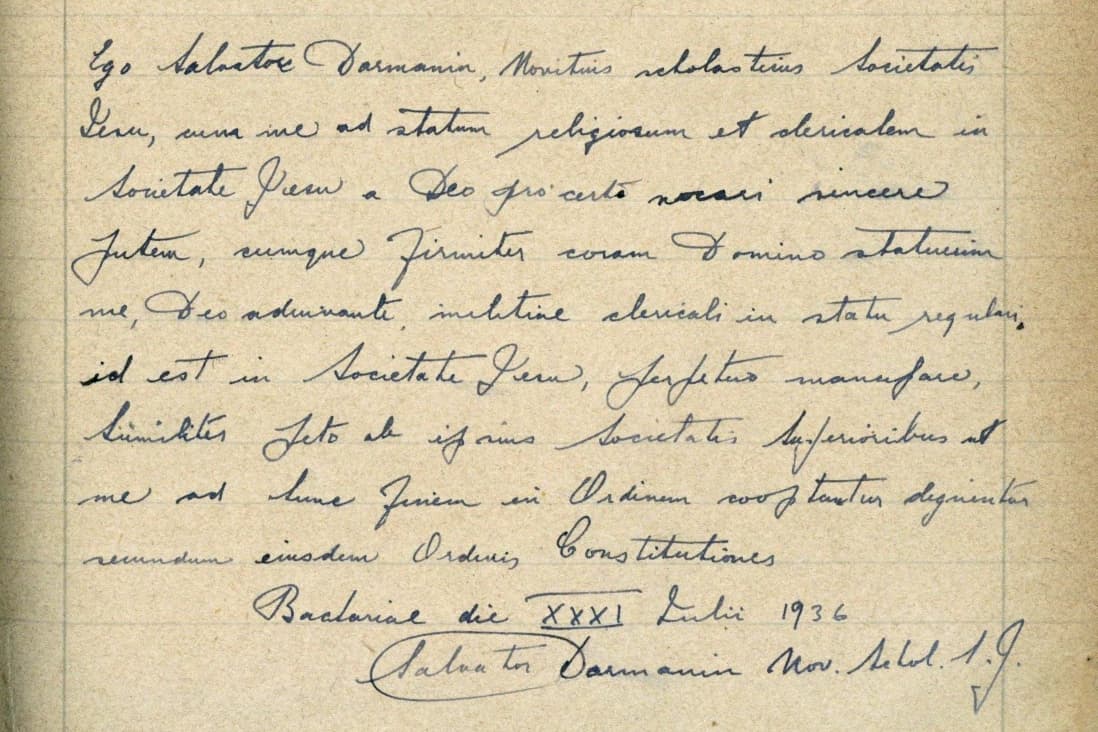
Although he was a Maltese Jesuit, as we have said, he was a member of the Sicula until 1947. The first evidence of his religious life can therefore be found in the Sicilian Province Archives. The photograph accompanying today’s episode shows the register of novices’ applications for their First Vows in the novitiate of S. Cataldo.
To reconstruct his years of study in the philosophy school of Gallarate and the story of his arrest, we must refer to the Veneto-Milanese Province Archives, as Gallarate was part of this province.
The rest of his life, on the other hand, is documented in the archives of the Province of Malta, preserved in Malta. The text written by his nephew is further evidence.
His story is also one of the many stories that link Maltese and Italian Jesuits, even before the unification of the provinces in 2017, which saw them working together, as in the case of the St. Joseph Recreation Centre founded by Fr. Strickland , and helping each other.
Stories of other Jesuits who were arrested
In the archives, we found information about other Jesuits imprisoned in concentration camps, including Fr. Slanislao Janiki , a Polish Jesuit. He too, once he was freed in the summer of 1945, did not want to talk about this dramatic experience. The vicenda di p. Gardin,, who was arrested by the Albanian government in 1945 and remained in prison camps for ten years, is very similar. At the same time, Jesuits Fr. Pietro Alagiagian e p. Pietro Alagiagian and Fr Pietro Leoni were also prisoners in Russia, where they remained for over a decade
These witnesses are no longer with us, and often chose not to leave behind any memories of what they experienced, because it was too painful to relive. Fortunately, their stories are preserved in the papers of our historical archives and will enable present and future generations of scholars to reconstruct their lives, passing on even the most dramatic events so that they may be remembered.
Maria Macchi