Italian Jesuits during the Second World War
How did Italian Jesuits experience the Second World War, the long months of occupation and the bombings? What emerges from archival sources?
“There is no question of ending the war”
We can find the answers to these questions thanks to research carried out in recent years by Dr Laura Di Fabio, now published by Viella. Storie di gesuiti nell’Italia occupata. Con estratti dai diari di casa della Compagnia di Gesù (1943-1945) Rome, 2026.
Thanks to the opening of the Pontificate of Pius XII, requested by Pope Francis on 2 March 2020, documents produced up to October 1958, when Pius XII died, are now available for historical research.
The scholar decided to analyse in particular the period of occupation, from 8 September 1943 until the end of the conflict, to investigate how the life of Jesuits in the communities changed, what contribution the fathers and brothers made to the population, and what differences there were in the various Italian territories. The originality of the text lies not only in its methodological aspects but also in the decision to publish the sources directly.
The book is divided into two parts: the first is a long essay presenting the situation of Italian residences during the occupation, contextualising it in relation to the war and the historiography on this subject. In the second part, the author presents several case studies based on the diaries of various residences. Readers can therefore consult the source material directly, transcribed and accompanied by extensive critical commentary. The researcher conducted her research not only in our archive but also in ARSI, the historical archive of the Pontifical German-Hungarian College, and that of the Vatican Observatory.
The case studies
The case studies consider residences in central and northern Italy where occupation lasted longer. The researcher studied in particular, for the Roman Province, the college of the Nobili di Villa Mondragone on the border between Monte Porzio Catone and Frascati, the Istituto Massimiliano Massimo, at the time located at Termini Station, the Germanic-Hungarian College in Rome, the novitiate in Galloro, the residence in Florence and the Ricreatorio S. Giuseppe; For the Veneto-Milanese Province, the residence in Gallarate, the Antonianum, and the Curia headquarters, both in Padua, were taken into consideration.
The “internal” perspective provided by the house diaries was further amplified by the personal diaries of two Jesuits from the Roman Province: Fr Giuseppe Massaruti, at the time a teacher at the Massimo – from whom the phrase “There is no question of ending the war” is taken – and Fr Audace Bellincampi, a Jesuit at the parish of St Robert Bellarmine.
Readers can immerse themselves in the events of the long twenty months of Nazi-Fascist occupation of Italy by consulting the transcribed sources directly, watching the front line shift over the course of days and months.
Another publication on the subject
In addition to Laura Di Fabio’s book, a volume has also been published recently, the result of collaboration between archivists from the European Assistance of the Society of Jesus: The Second World War through Jesuit Archives: The Case of Europe (1939–1945), 2026. Each archive has presented an overview of the collections it holds and where specific information and sources on the Jesuits during the Second World War can be found. Although in this case the book is more like a study room tool, it still has an informative slant. In addition, each archive has presented photographs, documents and objects that the reader can see reproduced in the book. As for the collective work of archivists during the Second World War, it is possible to view an online exhibition organised by the archive of the Province of Great Britain, thanks to the contributions of all the archives that participated in the initiative.
Sources
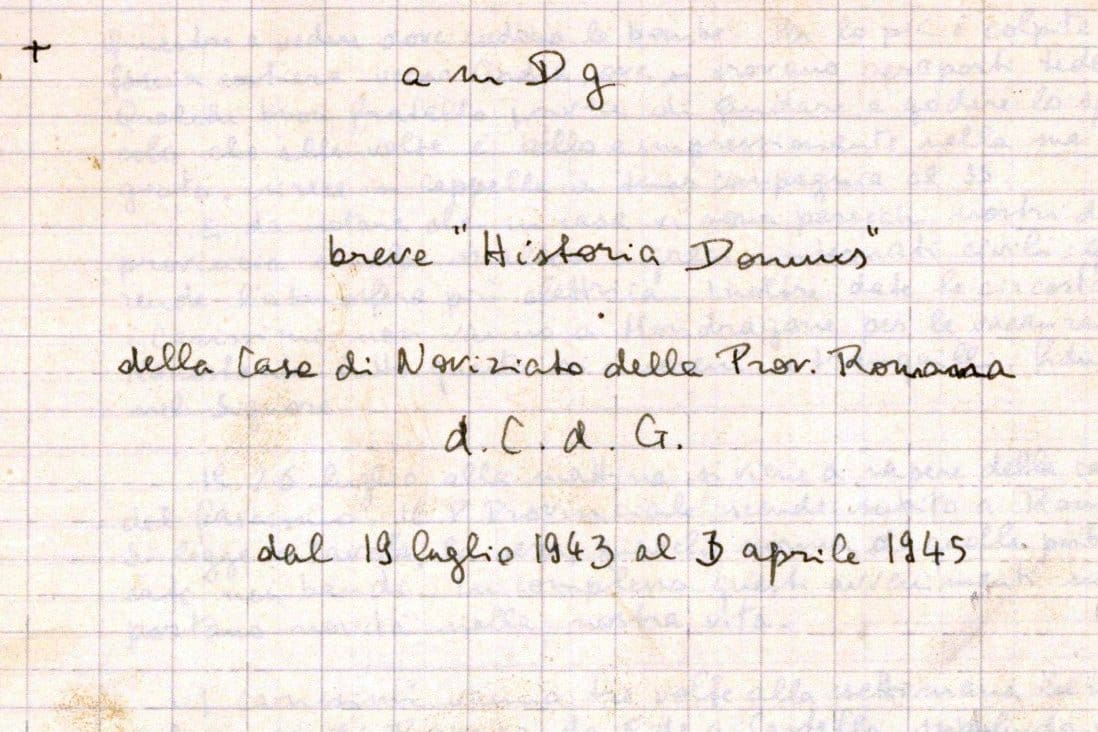
The Second World War left its mark on every type of documentary. The historiae domus written between 1940 and 1945 tell of bombings, air raid sirens, and the daily difficulties encountered by communities, obviously in different ways depending on the year and geographical location of the community.
The Gustav Line marked a boundary between residences in liberated territories and those under Nazi-Fascist occupation. Some of these were also occupied by the military, thus beginning a difficult forced coexistence between the Jesuit community and soldiers, as in the case of Gallarate.
The correspondence of the Superiors also tells us about everyday life, often characterised by power cuts, curfews, the organisation of food supplies and the reception of displaced persons. When considering the sources, we must bear in mind that we are in an era in which the telephone is widely used in everyday life and that often, especially in large cities, it is possible that for security reasons the Jesuits preferred to meet authorities or individuals in person rather than send them a letter.
Very useful sources are the household diaries that recount the bombings day by day, soldiers coming and going, troops occupying the house and then leaving, taking furniture and food with them, other troops taking possession of the rooms a few days later.
There are few personal diaries, a source that some Jesuits kept as a personal habit and which has not always survived to the present day. Among the diaries used by the researcher are those of Fr Giuseppe Massaruti and Fr Audace Bellincampi. Not that of Lorenzo Rocci, who lived in Villa Mondragone during the war years, as his diary ends in 1933.
Community life between 1943 and 1945
Although the difficulties associated with the war were already affecting communities and colleges, it was after the armistice that the situation deteriorated. In fact, the Nazi-Fascist occupation also affected many residences of the Society of Jesus. The Jesuits were aware of the risks they were running, yet in many cases they chose to open their residences to the population. In Frascati, after a dramatic bombing that destroyed much of the historic centre, the inhabitants of the town turned to the Collegio dei Nobili in Villa Mondragone. The Jesuits hosted up to nine hundred displaced persons in the weeks and months that followed, even hiding some Jews.
The College was not officially occupied, but German troops were stationed in the garden and high-ranking soldiers frequently visited the college. The Rector preferred to make the best of a bad situation, as reported by the scholastic Alberto Parisi, who kept the house diary. This is one of the very few cases in which we know the name of the person who kept the house diary.
The chronicles are often accurate and rigorous: the compilers of the sources are particularly aware of the historical moment they are living through and convey it to us with clarity.
One of the residences occupied was that of Gallarate. The military requisitioned an entire floor, and coexistence between the religious community and the military proved difficult from the outset. The superiors urged their confreres to ensure their safety and to have as little contact as possible with the noisy “tenants”. A note dated 13 April 1944, found in the Gallarate house diary, is particularly illustrative of the atmosphere in the community:
Rules that Fr. Minister reminds the philosopher brothers to remember and observe
- In the library, the windows on the occupation side must remain closed with the shutters down.
- Do not walk on the central terrace.
- During night-time alarms, silence must be observed. Stay quietly in your room or, if you wish, go down to the shelter or garden, without making noise in the corridors and with the lights off.
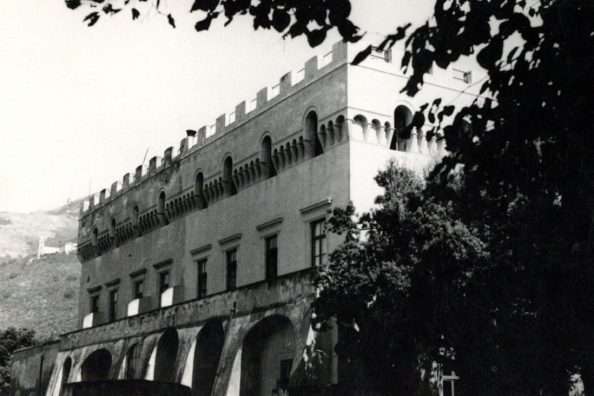
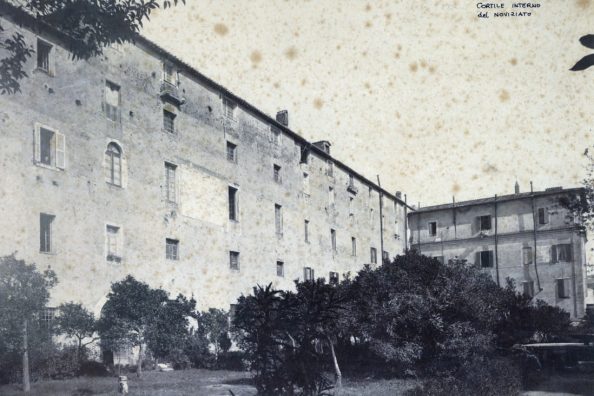
The Jesuits’ apostolate did not stop with the war but multiplied to bring assistance to those most in need. Assistance is given to soldiers who deserted after 8 September, who often ask for clothes so as not to be arrested. In the college in Padua, there are clandestine activities in support of the Resistance, and persecuted and displaced persons are welcomed. Bombings hit numerous residences throughout Italy. Some were razed to the ground, such as Leone XIII in Milan, while others were gutted and rendered unusable, such as the novitiate in Galloro or the Arici College in Brescia. Others suffered limited damage but still incurred costly repairs: at Villa Mondragone, all the window panes were blown out by a bomb that exploded in the garden. On his return from a retreat, Fr. Amadori died in Florence during the bombing of 25 September 1943.
These first two publications offer us different perspectives on the complex historical period experienced by the Italian Jesuits and on the wealth of evidence available to study it.
Maria Macchi