The novices’ magazine
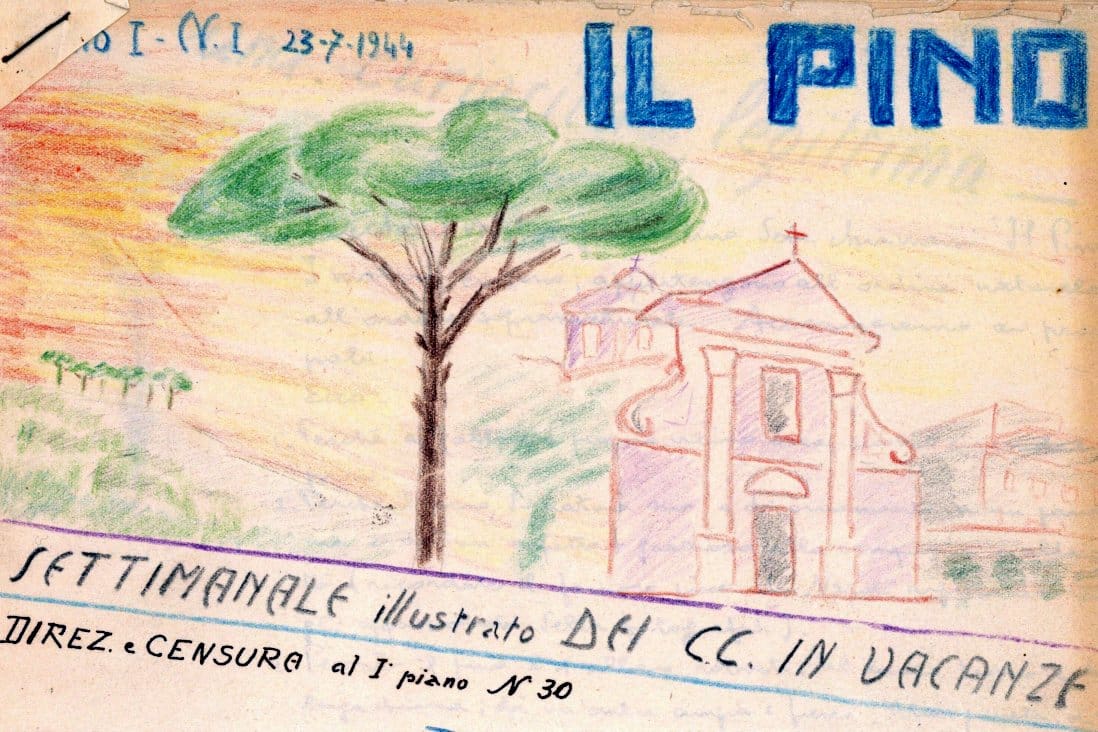
During the war, threatened by bombing, some novices and scholastics started a magazine to cheer up the community. Each issue contained articles, nursery rhymes, puns and illustrations.
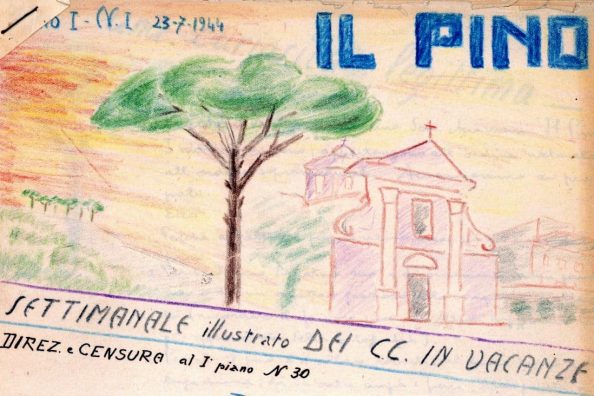
It was called ‘Il Pino’ and was the magazine of the novitiate of the Roman Province from 1944 to 1951. It was the product of the creativity of many hands and was never officially printed.
Do not try to look for it on the OPAC SBN, because you will not find it; moreover, it is not even listed in the list of magazines owned by our archive. The reason for this absence is simple: it is an entirely handwritten magazine, probably produced only one copy at a time. It was not even mimeographed, as was the case with the first issues of Il Mondragone, which were intended for a larger number of boarders. Only a few of the most recent issues of Il Pino feature typewritten articles, but the illustrations are always hand-drawn and coloured.
Il Pino is, to all intents and purposes, a document and can be found among the novitiate papers in the archives of the Roman Province. Leafing through it, one finds numerous pastel drawings that brighten up the pages: glimpses of the landscapes that could be admired from the novitiate, caricatures of novices and Jesuits, reflections of future fathers and brothers. Speaking of landscapes: the name of the magazine is linked precisely to the view that the novices saw from the window. The Galloro residence, which at the time housed the novitiate of the Roman Province, was surrounded by maritime pines, and this inspired the editors of the magazine, as they themselves state in the opening of the first issue. You can see the trees and the façade of the Sanctuary of Galloro accompanying today’s episode. For a few years, it changed its name to “Ai Monti”.
Entering the novitiate during the war
This magazine tells us a lot about the daily life of novices at the time. We do not have much information about its origins, but perhaps it was a way for the novices and their superiors to take their minds off the drama of the war that was raging. The novitiate was a place separated from the rest of the world and therefore surrounded by a large park. Despite the attempts of fathers and brothers to protect the novices – remember that at the time, one could enter the novitiate at the age of fifteen, and therefore as a minor – they would still have experienced the horror of the conflict first-hand. The novitiate in Galloro was constantly threatened by continuous bombing and raids by the Germans, who took away many supplies. Then, in 1944, the entire community was transferred for safety reasons to the Gesù in Rome, where they arrived after a long journey on foot, saving furnishings and objects on a cart pulled by the community’s donkey, Checchina. The decision proved to be a lifesaver, as the novitiate was hit by bombing and partially destroyed.
Life in the novitiate
Life in the novitiate, although simple, was not without humour, creativity and moments of leisure. This is clearly illustrated by the cartoons, scenes from everyday life and caricatures. Every occasion is a good opportunity to write an article: Delmirani’s puns, the skills of the Ciociaro cook – whose identity is not revealed – who stares at the water waiting for it to boil, the misadventure of the scholastic Giacomo Martina – who decades later would become a highly regarded Jesuit historian – bitten by a sandfly.
In one of the first issues, the novices imagine visiting the Uffizi Gallery on 25 July 2000 and illustrate various works of fiction: “Sadiglieria” depicting the bust of Fr Giammartina [a satirical version of the young Giacomo Martina] celebrated as “professor of yawning at the Pontifical Gregorian University”.
The long-awaited arrival of the catalogue, which is still prepared and distributed annually by each province, also deserves its place in the magazine. However, this is not the 1944 catalogue but an imaginary catalogue featuring novices and scholastics who have grown up and are now engaged in their apostolate: some have become Provincials, others assist the Scouts, the ever-present Fr. Martina teaches ancient languages, some have left the Society to become Carthusians and one has even been appointed Cardinal.

At the end of many issues there are riddles and charades, the solutions to which can be found in the following issue. Someone writes a fake obituary for Fr. Massimo Taggi, dating his death to 1985, while the Jesuit survived that prophecy by several years, dying in 2010. In another issue, Brother Zanca wrote a short article on how to build a radio at home, even drawing the diagram.
There were also pages dedicated to serious news: scholastics, fathers and brothers arriving in Ariccia, trips, updates on the war.
The scholastics never signed the articles with their own names but with nicknames, often very funny ones: “One of us”, “Magic”, “Fra Cosa”, “Iter”, “Tam”, “Pirre”, “Fasulin”.
Excerpts from the magazine
Although the novices were protected as much as possible from the reality around them, they saw the drama of war with their own eyes. Let’s read a short excerpt from one of the issues of “Il Pino”, the August 1944 issue, in which a member of the community recounts what he saw during a walk
Along the road to Rocca di Papa, at Legnara, where we had passed many times before, indifferent and in a hurry, without stopping, I found a small but significant change on my return. I saw it for the first time in passing, from the lorry that was taking me back to Galloro after five months away. I returned there on my first walk [when it was permitted to go for walks], and several times afterwards, drawn by a mysterious charm. In a corner of the clearing, where the meadow is about to return to forest, a small cemetery has sprung up, now almost entirely hidden by the grass that covers everything. Rough crosses, fashioned by rough hands, perhaps amid the rumble of cannon fire, surmount the small mounds. The names of the fallen, engraved on wooden tablets, are about to be erased by rain and time. They are difficult to read. But what does it matter? On most of the graves there is also a helmet […] now ruined by shrapnel and pierced by bullets. Soon, all that will be visible of the cemetery will be the large cross, which dominates and protects those who rest in its shadow. […] Young men torn from their homes in the prime of life, at the age of 20, led to their deaths far away, without their mothers there to comfort them in their pain and assist them in their agony. […] Suddenly, hundreds of four-engine planes fly overhead with their dull, monotonous, deafening noise. Where are they going? How many cities, how many houses will they destroy? How many lives will they take? The noise continues, weakens, and dies away completely. They will return in four or five hours, drunk with victory, blood, and slaughter.
Novitiates in other provinces
At present, no magazines or similar publications have been found in the other novitiates of the historic Italian provinces. However, the other archives are currently being reorganised and it cannot be ruled out that similar initiatives may also have been carried out in Lonigo, Avigliana, Portoré, Villa Melecrinis and Bagheria, the locations of some of the novitiates of the historic Italian provinces.
In previous episodes, however, we noted other peculiarities of these novitiates, such as the one in Naples, where the possessions that each novice brought with him were recorded. Other documents tell us about young men who arrived at the novitiate directly from college. Or the card made by the “philosophers” – the Jesuits studying philosophy in Portorè, who in 1904 wrote a greeting card to a Jesuit celebrating fifty years of religious life.
Maria Macchi