The life of Jesuits during Lent
How did community life change during Lent? There were several changes affecting both the food served at table and habits in the home. Let us read some passages from historical documents together.
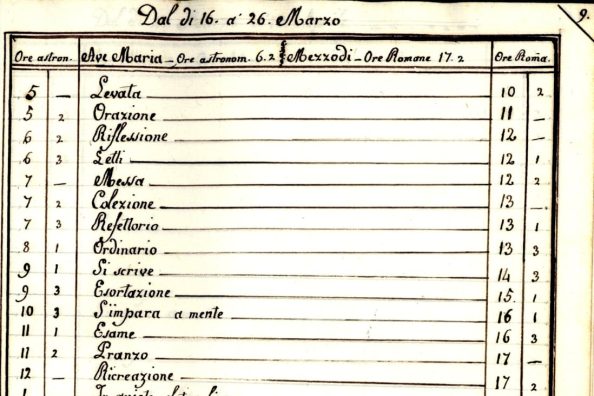
The source
Once again, customs come to our aid in investigating this particular aspect of Jesuit life. Today’s customs refer to the Old Company, as this is the only document dating from before 1814 preserved in the archives of the Roman Province. It has already allowed us to recount many aspects of the Jesuits’ life: table service and pantry supplies, the division of the day, the pilgrimages of fathers and brothers. Today, it allows us to investigate the life of the Jesuits from Carnival to Easter.
Lent is notoriously a time of preparation for Easter characterised by renunciation, sacrifices and fasting. However, not all Jesuits were required to fast. Those who were ill or unable to observe it for reasons related to their apostolate received a special licence and were exempted. However, licences were not only linked to the Lenten period but could be requested throughout the year: to smoke, keep personal items or consume food outside of meal times, always with stated reasons.
Carnival: before Lent
The period preceding Lent is marked by the celebration of Carnival. These are days, today as in the past, when people consume sweets and delicacies associated with this holiday, in short, they make exceptions to the rule, the last ones before Lent.
Even in Jesuit communities, customs tell us, meals were more abundant, especially on Shrove Tuesday and Shrove Thursday. Two appetisers or portions that were not usually provided were served.
Let us read together from the source:
‘On Shrove Tuesday [Tuesday before Lent], two good appetisers and a double dessert are served. On the following Friday, there is no abstinence, even though an appetiser is served in the morning. On Saturday, an appetiser is also served. On these two days, eggs and soups are made with butter. […] On Tuesday, two starters are served, followed by a double dessert. In the evening, in addition to salad and a main course, cake and dessert are served.
However, there are also other indications. For example, it is specified that during Carnival, Jesuit brothers should not be allowed to go near the main street. This is where people gathered for jokes and parades. Shows were often organised by theatre companies and travelling troupes, and street vendors sold their wares. This atmosphere was considered perhaps too risky and likely to lead to temptation.
Lent
Per quaranta giorni nelle comunità gesuitiche vengono applicate una lunga serie di regole volte a limitare il cibo, organizzare l’apostolato di padri e fratelli e presidiare la chiesa.
Let us read again from the source what the restrictions were:
‘The list is given to the cook and the dispenser for the food to be given during Lent, after it has been seen by the Rector […]
At the beginning of Lent, it is customary to speak to the doctor about those who cannot observe it, and the licence [permission] is signed by the doctor himself and then sent to Our Father so that he too can sign it.
The coadjutor brothers are usually sent to preach one day a week, two or three at a time, depending on how busy they are, or all on the same day. The novices and third-year Fathers go twice.
After the evening meal, food is given only to the brothers who work hard, i.e. the bricklayers, carpenters, bakers, when the bread is made, and gardeners. It is also given to the “bucatari” [those who do the laundry] when they do the laundry, and to the gardeners, depending on how hard they work. […] Regarding the convalescents. All those who are notified by order of the Fathers as coadjutor brothers and novices will eat at the table assigned to them. No salami is served as an appetiser, but figs are served instead.”
It is interesting to note that the brothers are not allowed to visit the tombs of other churches.
Easter
During Holy Week, preparations for Easter Sunday are in full swing. While fathers and brothers take turns in the church, in front of the tomb, in the confessionals and in front of the altar, there is much to do in the kitchen. Among other things, there is no shortage of advice on household economics:
‘The bakers make doughnuts with butter for Easter morning, and bread if that of Maundy Thursday and Good Friday is not enough for the festivities. […] […]
During Lent and other days of fasting, as fish is not available at the usual price, it should not be bought but made, with “cucuzze” [pumpkin], or fritters, or cake or tuna in sauce, first soaked and then changed the water several times.”
The rise in prices during periods of high demand, therefore, is not unique to today’s society but also occurred in the past, as demonstrated by the issue of the cost of fish. Custom also tells us that in January, or in any case before Lent, fish is usually bought to be marinated and kept ready for the long weeks leading up to Easter, “if it is cheap, however”.
Maria Macchi