A Jesuit’s day
How was a Jesuit’s day structured in the past? And how has his daily life changed over the centuries? Today, let’s take an imaginary trip to a residence of the Society of Jesus to follow the life of a member of the Order from the moment he wakes up until he goes to sleep.
Sources
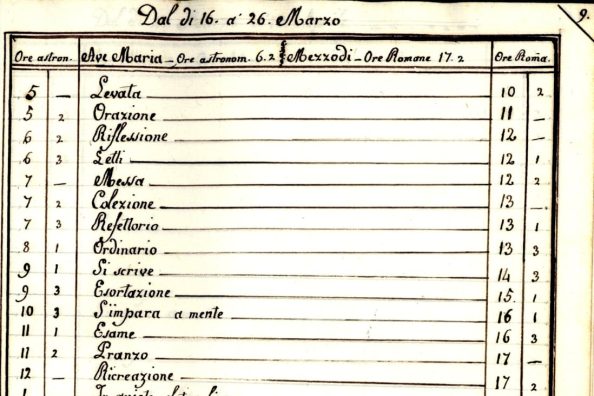
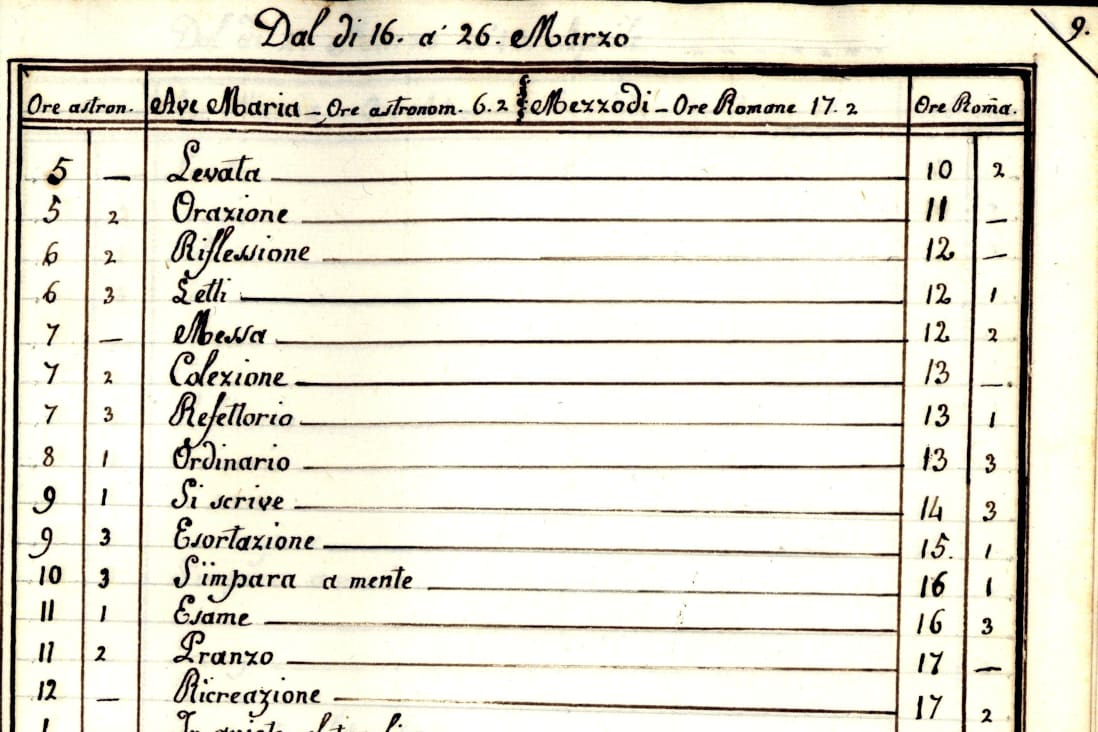
There are numerous sources that allow us to reconstruct the day of the fathers and brothers: house diaries, visit memoirs, catalogues. What accompanies us on today’s journey is a register of customs from the novitiate of St. Andrew at the Quirinale. It is particularly valuable because it is one of the very few sources dating back to the Old Society preserved in our historical archive. For the same community, we have both the volume dating back to the Old Company and the one compiled in the 19th century. We can therefore compare timetables and tasks.
Customs
What are customs? They are a collection of rules in force in those particular communities and relating to various aspects of community life: meals, their preparation and service in the refectory, the cleaning of rooms and chapels. This source is often found in novitiates, scholasticates and colleges in different provinces. It also contains a list of duties related to specific roles such as librarian, barber, porter and nurse in the community. This register has already allowed us to recount various aspects of the Jesuits’ lives, demonstrating that the same source can be useful for researchers engaged in completely different fields of study. The customs of St. Andrea’s have provided us with information on the vocabulary of food served in the community, on the corporal punishments prescribed for undisciplined novices, and on the itineraries of Jesuit pilgrimages. Even today, it helps us to recount the daily life of the Jesuits, hour by hour. At the beginning of the register, there are several pages dedicated to the months of the year. Each page shows the times of the day and the activities planned for those hours.
Twenty-four hours in the life of a Jesuit
Since the timing of various activities, before the advent of electric light, depended on the available natural light, it was essential to set the times for waking and sleeping according to sunrise and sunset, which change from month to month. For this reason, the times for waking, various daily activities, and rest in the register change to adapt to the sunlight. They also had to be well organised, considering the number of candles needed to light the rooms after sunset. In fact, the Jesuits continued their apostolate even after sunset. Let’s compare a day in January with one in June to observe these changes. Before delving into the daily life of a Jesuit, we must remember that schedules were not calculated from midnight, but according to other criteria: sometimes from dawn, sometimes in the religious world from lauds or vespers. The times given in the customs are calculated from sunset.
January – Ancient Society
In January, people woke up at “12 hore”. Considering that the sun sets between 4.50 p.m. and 5.10 p.m. during this month, the Jesuits woke up around 5 a.m. Below is a table showing the times indicated in the customs, with the corresponding modern time in square brackets.
| Rising | 12 o’click | [5] |
| Oration | 12:30 | [5:30] |
| End of prayer | 13:30 | [6:30] |
| Examination | 5:45 | [10:45] |
| Dinner | 18 | [11, meaning the first meal of the day. The source specifies that on fasting days, lunch is served instead of breakfast, as the days are short] |
| End of recreation | 19:45 | [11:45] |
| Evening | ||
| Exhortation | 2 o’clock | [18] |
| Dinner | 2:30 | [18:30] |
| End of recreation | 4:15 | [20:15] |
| Examination | 4:30 | [20:30] |
| Bedtime | 5:00 | [21:40] |
These moments marked the Jesuits’ day, and in between them, each one devoted himself to his own apostolate. In the communities of the Society of Jesus, each member had a role and various tasks assigned by the Provincial, but also other apostolates entrusted directly by the Superior of the community. To learn more about them, you can consult the glossary that our archive has made available to researchers. It was essential to know the customs and schedules of the month in order to adapt one’s duties to the community’s schedule, especially for those who had the task of waking up their brothers, for the cook and the brothers in charge of preparing breakfast, or for those who had to say the first Mass in the morning.
June – Ancient Society
The timetable changes significantly in June. Customs specify that from 8 May to 8 August, new timetables are in force compared to the winter months.
Jesuits rose at 8, around 4:30 in the morning, and then carried out all their other duties. Rest time was set for one hour after sunset, around 9 p.m.
New Society
Comparing the two registers, we discover that the daily life of the fathers and brothers of the Old and New Companies was not so different. The most significant changes would only come about during the 20th century. In the register of the New Company, the timetables are identical, but additional tasks are included, and both the “astronomical” times, i.e. today’s times, and the Roman times, based on sunset, are given. Let’s look at a typical day in January.
| Rising | 12 | [5] |
| Oration | 12:30 | [5:30] |
| Reflection | 1:30 | [6:30] |
| Beds | 1:45 | [6:45] |
| Mass | 14 | [7] |
| Breakfast | 2:30 | [7:30] |
| Refectory | 2:45 | [7:45] |
| Extra work | 3:15 | [8:15] |
| Manual labour | 3:45 | [8:45] |
| Exhortation | 4:45 | [9:45] |
| Memorisation | 5:45 | [10:45] |
| Examination | 6:15 | [11:15] |
| Lunch | 6:30 | [11:30] |
| Recreation | 19 | [12] |
| Quiet time at the table | 20 | [13] |
| Rosary | 8:45 | [13:45] |
| Manual labour | 21 | [14] |
| Doctrine | 9:30 | [14:30] |
| Stations | 10:30 | [15:30] |
| Walk | 10:45 | [15:45] |
| Beds | 11:45 | [16:45] |
| Ordinary | 24 | [17] |
| Writing | 1 | [18] |
| Free time | 1:30 | [18:30] |
| Points | 1:45 | [18:45] |
| Oration | 2 | [19] |
| Litany | 2:30 | [19:30] |
| Dinner | 2:45 | [19:45] |
| Recreation | 3:15 | [20:15] |
| Points | 4:15 | [21:15] |
| Examination | 4:30 | [21:30] |
| Rest | 5 | [22] |
As you can see, there are more tasks during the day, especially for novices or scholastics, such as the time devoted to memorisation, one of the methods used for lessons. The novitiate timetables of the 19th century probably had more deadlines than in previous centuries, but this does not mean that they were not planned, but rather that customs considered them implicit in the structure of the day.
The life of Jesuits today
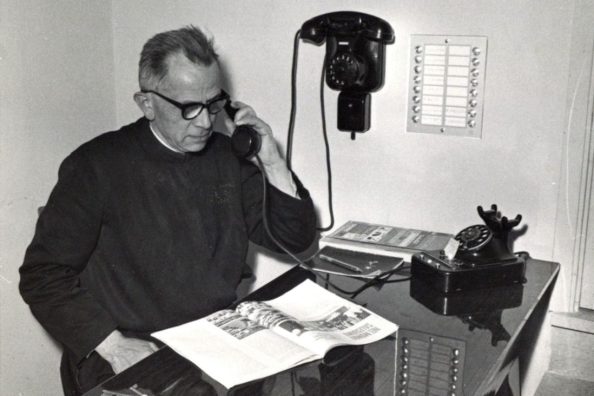
Many roles performed in the past by members of the community have now disappeared thanks to technology. For example, there is no longer a Jesuit in charge of waking up fathers and brothers in the morning; alarm clocks take care of that.
In the morning, a Jesuit from the community takes turns celebrating Mass, and many of his brothers take turns throughout the day and week hearing confessions in the church for the faithful.
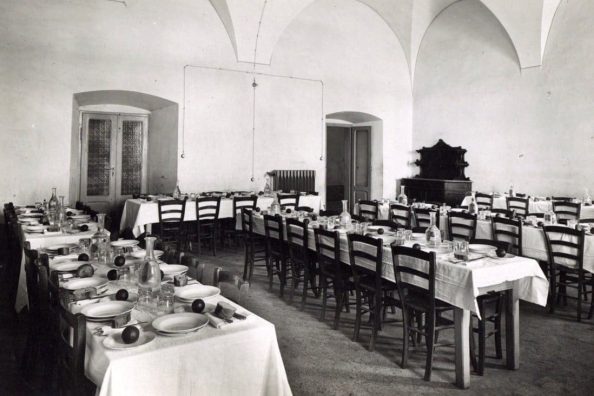
The biggest change is probably related to mealtimes. There is no longer the custom of eating in silence, listening to the Jesuit in charge of reading, nor is there the monastic custom of eating on one side of a long table. Today, Jesuits eat at smaller tables that encourage conversation in groups, and there is talking at the table, as we remember that a religious community is a family. The times for breakfast and dinner are no longer fixed, as the apostolate of the fathers and brothers varies and may require them to leave early: some teach at school, some have to open the church, some are on confession duty, some hear confessions in prisons or hospitals, and some leave to give retreats. Lunch times, on the other hand, are usually fixed, allowing the community to gather at least once a day to eat together. Before lunch, the fathers and brothers meet in the chapel to pray together. Dinner is also eaten together, but often at different times, depending on the commitments of the various Jesuits.
Many of the changes in community life, not only for Jesuits but also for other religious orders, date back to the reforms of the Second Vatican Council, which also modernised the way religious people lived, often toning down outdated traditions. Corporal punishment, for example, has been abolished since the 1960s, as has the use of hair shirts.
Today, it is certainly not possible to describe a standard day for a Jesuit, as schedules depend greatly on roles and assignments. There are fathers and brothers in senior positions in the Province who often travel for consultations or commissions, while others have assignments in both Italy and Malta and therefore live some days in one community and others in another. However, there are still some points in common with the past: early wake-up, prayer, and communal lunch.
Maria Macchi