The Annual Catalogue of the Province
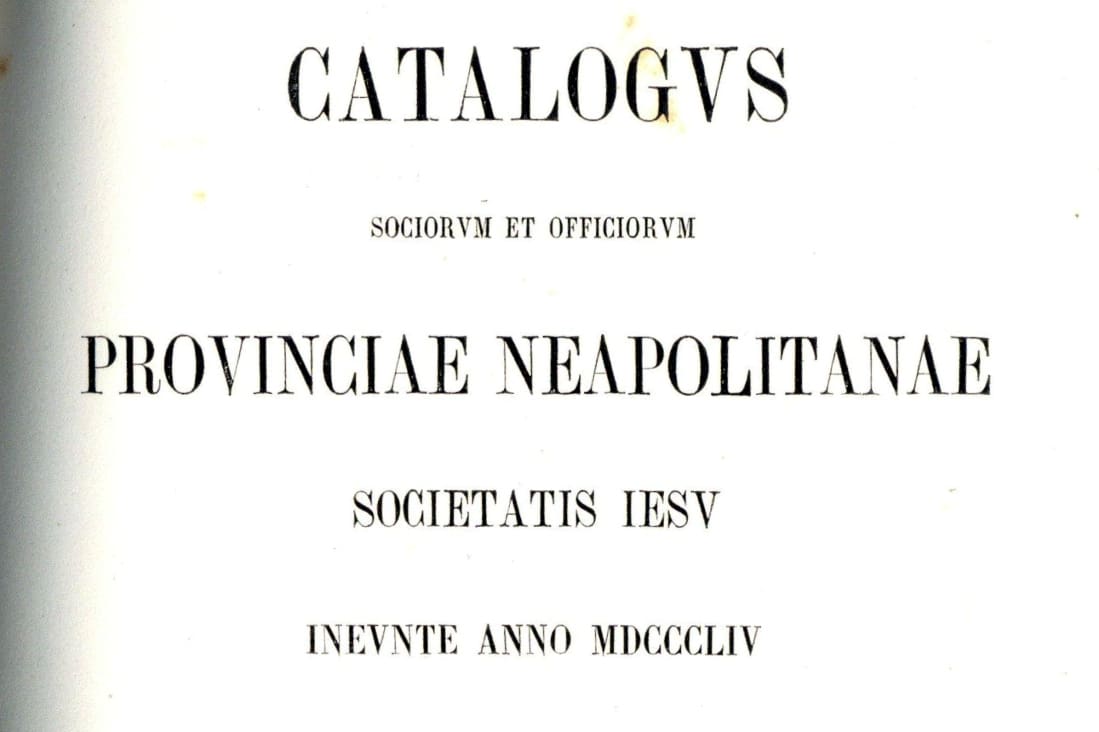
Every year, each province of the Society of Jesus prepares its own catalogue of Province communities, works and Jesuits who live and work there. How was the catalogue prepared in the past and what papers can we find on this source?
Use of the source
For Jesuits, the catalogue is a veritable handbook for keeping track of the contacts of their confreres, the offices of the Province and all the churches and parishes. They can look up the name of a father and a brother and check where he lives, they can check the anniversaries of religious life to send greetings to their confreres and find the list of deceased Jesuits.
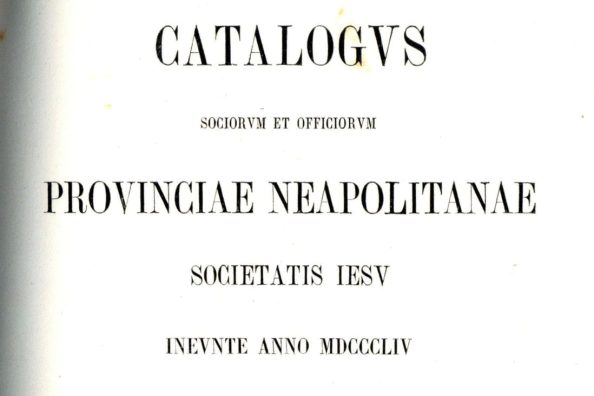
In addition, known by the amusing name of “bugiardino” (leaflet) in some Italian residences, due to the inevitable errors it contains, it is also a valuable source for historical research. For scholars, it is often the first point of reference for reconstructing the life of a Jesuit, together with the Catalogus defunctorum. Thanks to the annual catalogue, it is possible to follow a Jesuit from his entry into the novitiate until his death or resignation. ARSI, the central archive of the Society of Jesus, has digitised the catalogues of all the Provinces from 1814 to 1950. Dozens of users consult them daily.
The presence of errors is not something that can only be detected today; archivists also find several errors in 19th-century volumes in the course of their work. As it is a human product and, above all, contains a large amount of numerical data, it is inevitable that it is not perfect; in fact, a page of “errata corrige” often accompanies it. However, errors and misprints do not invalidate the value of the source, as it must always be considered in relation to others, such as the Catalogus defunctorum and all the manuscripts and official documents in the archive.
Faced with a mistake, the researcher checks the papers contained in the Jesuit’s personal file to determine the correct date or information.
Compiling the annual catalogue in the 19th and 20th centuries
So far, we have not found any sources that tell us how the catalogue was compiled in the 19th century.
Although the provinces were smaller than they are today, it was certainly less easy to transmit information from the Provincial Curia to each community, at least during the first decades of the 19th century.
We know that during certain periods, for example between 1848 and 1851, it was not possible for many Italian provinces to write the catalogue and have it printed.
For this reason, handwritten copies were made, often consisting only of an alphabetical index or a list of Jesuits present in the province with some brief information about their main apostolate. Even in the 20th century, several provinces were unable to print their catalogues during the two world wars.
Instructions for the catalogue
Although we have not yet found any information about the 19th century, we do know how catalogues were produced from at least the end of the 19th century and throughout the 20th century. The procedure was not so different from that still followed today.
The source for today’s episode was found in the correspondence of the community of Bassano del Grappa.
In October 1944, the Provincial of Veneto-Milan, Fr. Domenico Bianchini, wrote to all his communities about the forthcoming publication of the new annual catalogue. The timing is similar to todays, which we will discuss in the last paragraph. Let us read Fr Bianchini’s instructions together:
As the time approaches for the publication of the new Catalogue of the Province, I kindly ask Your Reverence to send me the partial list of this house by 30 October. In this regard, I would like to strongly recommend the following:
It should be written clearly and accurately, preferably typed.
Follow the order of family surnames (with the exception of the Superior and the Minister).
Keep the abbreviations and punctuation already in use.
The sheets should be written on one side only, with wide margins and ample space between lines.
Please inform Fr. Socio of any errors or omissions that may have occurred in the previous catalogue, especially in the Index alphabeticus.
In fact, in the catalogue, the Jesuits who live and work in each residence are in alphabetical order. The only exceptions are the Superior and the Minister, who are at the beginning of the list, according to hierarchy. The catalogue was always in Latin for all provinces, but recently this has been abandoned in favour of English. Our province adopted this change in 2018. Apostolates and assignments were often abbreviated, which is why our archive has recently compiled a glossary.
The preparation of the catalogue in our times
Today, the preparation of the catalogue follows in part the procedures described in Bianchini’s letter. It involves several people, from the Father Socius to the Provincial Secretary, who, having received the destinations for the new year, work on the pages of the new catalogue between July and September, up to the superiors. The latter usually receive the file for their community between the beginning and middle of September, with a request to make changes and report errors.
Even if the page already contains the names of the new members of the community, the Superior may assign them additional tasks to be carried out in the house (the writer of the historia domus and the prefect of health are chosen by him), which must then be added. In addition, community-related organisations – schools, parishes, oratories – communicate their data to the superior: the number of members, names of collaborators and contact details.
The enriched and modified file is sent back to the Provincial Curia, which compiles all the various texts along with the other parts of the catalogue: the list of religious jubilees, the offices of the Curia, the overview of Jesuits in formation, the numbers of the Province, and the alphabetical list.
The file is sent to the graphic designer and then to the printers at the end of the year, to be distributed to the Jesuits in PDF and paper format in the following weeks.
Today’s episode is dedicated to the current Father Socius, Fr. Paul Pace, and his predecessors, and to the Provincial Secretary, Dr. Giovanna Sedda, to thank them for this hard, long and painstaking work, which today is useful to the Jesuits but which in the future will be the basis for hundreds of studies by scholars and archivists.
Maria Macchi