1814: the Restoration of the Society of Jesus
After its suppression, in 1814 Pius VII officially re-established the Society, by the Bull Sollecitudo Omnium. What remains in the archives from those early years?
The suppression
As researchers of the Old Society, who often contact us for their research, are well aware, almost nothing from before 1814 is preserved in our archives. By Old Society, we mean the period beginning with the founding of the Order in 1540 and ending in 1773. The suppression is therefore a highly significant event in the history of the Society, a sort of turning point.
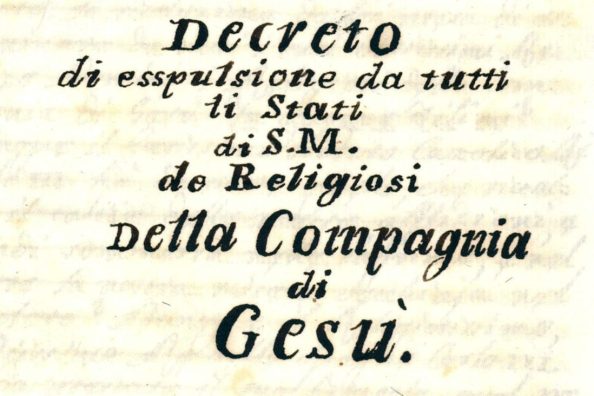
The Society of Jesus was officially suppressed until 1814, except in the territories of White Russia. In the Kingdom of the Two Sicilies, it was readmitted as early as the beginning of the 19th century.
However, nothing remains in our Archives of the collections of colleges and residences, except for a few scattered and rare documents: very few have emerged so far. This is due to the confiscation of the Society’s properties and the seizure of archival and library collections by the ancient Italian states.
Many researchers turn to our archive, the ARSI, the Gregorian archive and other Jesuit archives in Rome to find out if we also hold papers dating back to the four decades in which the Order did not exist.
During the years of suppression, the Society did not disclose or produce any documentation. The papers of Jesuits who continued to live as lay people or religious in other orders ended up in their private archives or, much more often, were lost.
1814: a difficult year to reconstruct
We might therefore think that, starting with the promulgation of Pius VII’s Bull, the archival series resumed, the house diaries were compiled again, and the files were opened. That, therefore, every archival source begins with that fundamental year of 1814. Unfortunately, this is not the case. In reality, we have very little material for the first decade of the reconstitution, for various reasons.
The Society of Jesus did not immediately regain all the colleges it had previously lost, some of which never returned to its possession, but slowly the Jesuits tried to reorganise and return to the cities, opening new residences thanks to new bequests from benefactors. The first to map the number of colleges and residences gradually returned to the Jesuits was Pietro Galletti, a Jesuit historian and author of the text “Memorie storiche intorno alla Provincia Romana della Compagnia di Gesù dall’anno 1814 all’anno 1914” (Historical Memoirs of the Roman Province of the Society of Jesus from 1814 to 1914). It took years for the Order to regain its widespread presence in the ancient Italian states.
Unfortunately, the documents produced in the early years of the Jesuits’ return to their historic residences are fragmentary, and in many cases have been largely lost. Certainly, at least initially, there was no concern to identify a place for the archive, since the residences and colleges did not have any ancient or historical documents. Therefore, the documentation was formed gradually, and only later was the need felt to organise it and store it in a suitable place. For example, the novitiate of St. Andrew lacks the memoirs of the novices who entered in the early years after its reopening. The councils also have significant gaps.
However, what has most affected the preservation of the documents has been the history of Italy.
The process of national unification, which took place in several stages, starting with the Carbonari uprisings of the 1830s, leading to the unification of Italy in 1861 and then the capture of Rome in 1870, resulted in the Jesuits abandoning their residences and often losing many documents.
A recent discovery
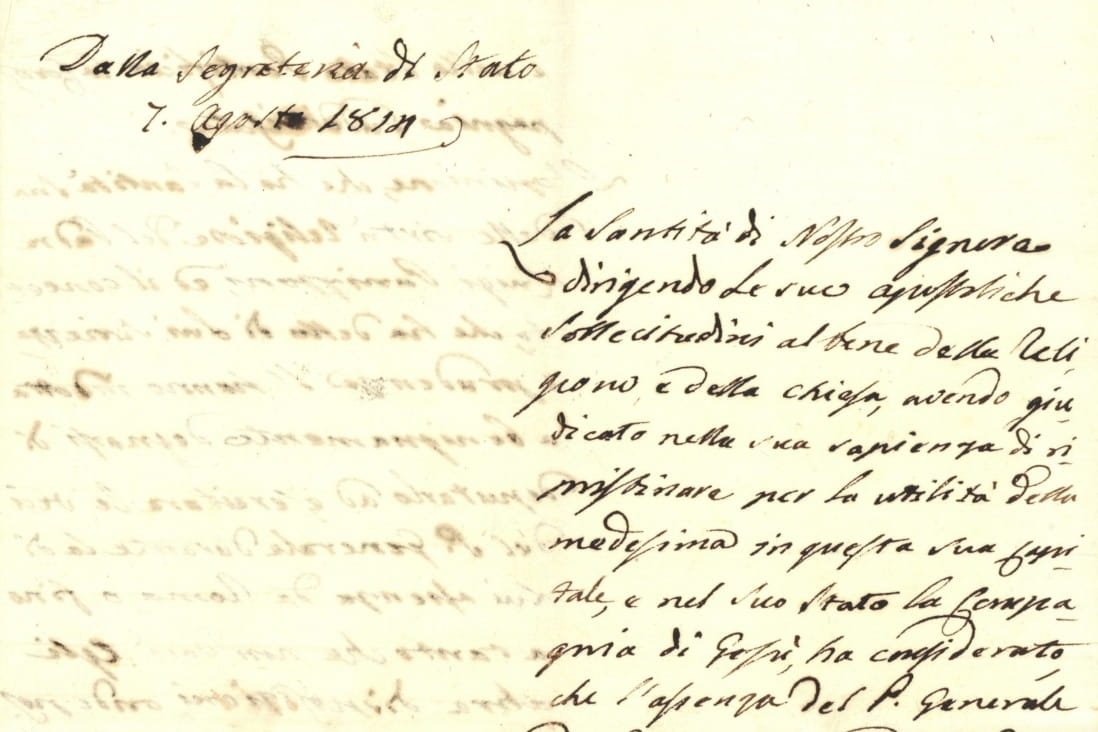
In reality, the Historical Archives always have a few surprises in store for us. Many collections are currently being reorganised, so as the inventory is being written, documents are becoming known, and the archivist is making other discoveries during their daily work assisting scholars. During one of these daily searches, a document was found that allows us to go back in time to 7 August 1814, during the ceremony of the restoration of the Society of Jesus, attended by the Pope.
The file of Fr Luigi Panizzoni, a Jesuit from the Roman province, contains some letters and copies of letters written by himself and other Jesuits dating back to the early years of the restoration of the Order. Let us read the words with which Fr. Emanuele Blanco recounts this historic day.
Having arrived safely in this Alma city, I hasten to bring Your Eminence the long-awaited auspicious news of the publication of the Papal Bull, which followed in this manner.
Yesterday, Sunday 7 August, the octave of St Ignatius and the feast day of St Gaetano, the Most Holy Father, as Prince and Supreme Pontiff, went to the magnificently decorated and solemnly illuminated Church of the Gesù, where His Holiness celebrated Mass at the altar of St Ignatius. The Mass was attended by 18 cardinals, a large number of prelates, the Queen of Etruria, a large number of Roman nobles and princes with their entire retinue, followed by all the Jesuits, numbering almost one hundred. The Supreme Pontiff went to the great hall of the College, which already served as an oratory for the Congregation of Nobles, and, ascending jubilantly to the throne, with everyone seated in their designated places, he had the Apostolic Bull published to such an imposing assembly, which begins ‘Sollicitudo omnium Ecclesiarum’, which restored the Society of Jesus to its former state throughout the Catholic world, recommending the re-established Society to the sovereign princes and bishops and exhorting them to protect and defend it in their states and dioceses. After the Bull was solemnly published in the presence of such an important assembly, His Holiness deigned to admit all the Jesuits present to the greater pleasure of kissing the Sacred Foot; After that, he had a benign handwritten document read, in which the Holy Father ordered and commanded that the Church and House of Jesus and the Church and House of the Novitiate at S. Andrea a Monte Cavallo, with all their possessions and appurtenances, be promptly returned to the Jesuits, reserving the return of the Roman College for an appropriate time.
The news spread: the Society had been re-established. Other letters preserved in the file testify to the Society’s desire to reorganise itself and the feverish requests of fathers and brothers to be able to return to their former houses and colleges, awaiting an invitation to do so (perhaps fearing that the news was not true or, in any case, preferring to be cautious).
Fr. Panizzoni writes from the Casa del Gesù in Rome, just two months later, in response to a letter he has just received:
What you add about the invitation, which those old Jesuits were expecting from me, really surprised me, nor have the other Jesuits in other places already done so, but one writing from a city still mentioned the wishes of the others he named. I do not know of many, whether they are more lively, whether they have the desire, whether they are able to work, etc. Those who love their vocation ask and show themselves, expose what they can do and do not wait for an invitation.
Secondly, there are many cities requesting the Company, many vocations, and some distinguished ones, so that due to lack of space I must leave a third of them behind, assuring them for another year. This House of Jesus is now full with those I am expecting, so I cannot admit others, much less invite them. When I begin to divide the subjects among the colleges, which must be organised in order to be inhabited, then I will accept Jesuits who are able to work willingly from hand to hand, but it is necessary that they first show me their affection for their vocation. Communicate these feelings of mine to those Fathers for their regulation and mine.
Finding the sources
Why are these letters found in the personal file of a Jesuit? If a researcher did not know that Fr. Panizzoni was involved in the organisation of the Jesuits immediately after their reconstitution, they would never find this correspondence.
We can formulate hypotheses as to why these letters are here. The correspondence of the Roman Province, but also that of the other Provinces, is very scarce, especially for the nineteenth century. This is too much to assume a low influx of letters, especially knowing that we are talking about a time when the telephone did not yet exist, having only come into use in communities in the 20th century, and the telegraph was only used for short communications. What happened to the correspondence?
Unfortunately, as the study of the archives shows, many Jesuit archivists, in an attempt to organise the archives, often dismantled some series to create others, in a completely arbitrary manner.
The case of the series of personal files of the Roman Province is emblematic in this sense.
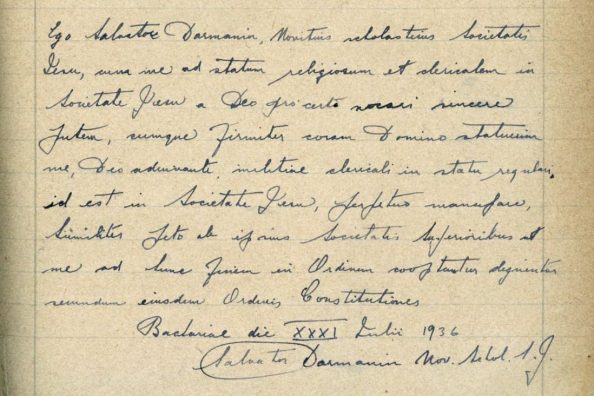
This is not an original series; in fact, the file is an archival unit that became widespread starting in the Napoleonic period. The contemporary signatures on the baptismal certificates, final vows, and parish records preserved in many documents in this series reveal another order. There were probably series organised by document type: the series of baptismal records, obituaries, vows, and so on. At some point, probably in the 20th century, someone decided to extract the documents of each individual Jesuit and create a personal file, probably for use in the current archive for living Jesuits. The same producer, although incorrect from an archival point of view, nevertheless carried out this practice.
Correspondence was also often broken up and ended up in individual files, just as the correspondence of individual Jesuits found in their rooms was placed in this archival unit.
We could consider conducting a thorough search and checking all personal files, one by one. Unfortunately, the Province of Rome alone holds 3,005 personal files. We must therefore rely on inventories, which often indicate the presence of particular letters or documents, but also hope for the chance discoveries that occur every day in the Archives.
Maria Macchi