The hierarchy in the Society of Jesus
Father General, minister, associate, major superior. Researchers quickly learn that in order to navigate the sources, catalogues and lexicon of the Jesuits, it is essential to understand the hierarchical structure of the Society: what the roles are, both senior and junior, and what the corresponding duties are. Many Jesuits are appointed superiors or ministers during their religious life, some become provincials, and very few become fathers general.
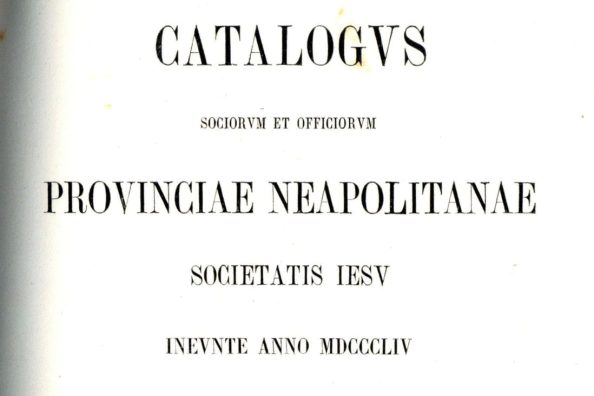
Every historical catalogue begins with a section dedicated to the General Curia, which until 1870 was based in the residence of the Gesù in Rome. At the end of the 1920s moved to its current location in Borgo Santo Spirito. This is followed by pages dedicated to the Province, which list the name of the Provincial, the date of his appointment, the Socius, the consultors and the offices of the Curia, followed by the communities of the Province in alphabetical order with all the names and positions of the Jesuits who live and work in them. The catalogue is an indispensable source for reconstructing the biography of a Jesuit. Here is a short list of the offices that make up the hierarchy of the Society of Jesus.
Fr. General
The Superior General, or Father General, is the head of the entire Society of Jesus and is elected during the General Congregation. He holds the position for life, although Fr Kolvenbach resigned as General upon reaching the age of eighty, as did his successor. In the past, the figure of the Father General was also improperly named as the “Black Pope”, precisely because the position is held for life, just like that of the Pope, unlike other religious congregations where it is temporary. The adjective “black” was linked to the black cassock worn by the Jesuits. The Society does not have its own habit, but Jesuits dress like diocesan clergy. The Father General resides in the General Curia, which has always been based in Rome but which, in certain historical periods, has been temporarily transferred elsewhere, for example to Fiesole in the 1880s and 1890s.
Assistente
Father General could not carry out his duties alone, without the help of several collaborators. Among these are the assistants. The Society ideally divides the world into different territories: provinces, for each of which a Provincial is appointed. Several provinces can form an assistance, headed by a Jesuit who works in the General Curia and reports to the Father General on matters related to that assistance. The assistant supports the work of the General and is a point of reference for provincials who need to resolve certain issues. Assistants live in the General Curia.
Postulator
This role is not unique to the Society. In fact, this figure also exists in the Curia of other religious orders or in diocesan Curia. The postulator is responsible for the processes of canonisation, and it is to him that bishops who need to request a first or second-class relic turn. A single postulator is appointed for the Society, who lives and works in the General Curia.
Major Superior or Provincial
The Provincial, or Major Superior, is the head of the province. He is called Major Superior to distinguish him from the superior of each community and residence. The term of office lasts three years and is renewable for another three years. The Province corresponds to a specific territory. In the past, its boundaries roughly followed those of the ancient Italian and European states, which is why there were five historical provinces in Italy. However, their unification did not follow the timing of the national unification process, as it was an internal administrative division within the Company. In fact, the five historic Italian provinces were only unified in 1978, more than a century after the birth of the Italian State. Some residences located near the border dividing two or more provinces have been part of both, over the decades: this is the case of Brescia, Modena, Parma and Reggio Emilia, which belonged to the Roman Province until 1846 and then passed to the Veneto-Milanese Province the following year. The residences of Terracina and Genzano, formerly part of the Province of Naples, passed to the Roman Province after the unification of Italy.
One of the Provincial’s tasks is to visit all the residences in his province every year to meet with all the Jesuits for a personal interview. He visits the works and meets the directors and their collaborators, most of whom are now lay people. He presides over the canonical council, together with his consultors, once a month, to govern the Province. He is in constant contact with the Father General to send him reports on the canonical visits carried out and to update him on matters relating to the province.
Socius
He is the Provincial’s right-hand man, helping him in his work: he drafts documents, organises the Provincial’s appointments, takes care of his correspondence and the minutes of the consultations. He also has the task of admonishing him: he advises the Provincial, offering him spiritual support.
Consultor
Together with Socius, the consultors make up the provincial council. Each Provincial appoints his consultors, who remain in office until the appointment of his successor. The Consult is the governing body of the Province: it meets every month and decides on ordinary matters – proposals for final vows for Jesuits who have completed their third year, the opening or closing of residences, the appointment of superiors – and any extraordinary matters that may arise. Extraordinary consults were convened during the war, for example.
Delegate
The delegate is a senior figure responsible for specific areas. It is a more recent figure that is not found in 19th-century catalogues. Today there are delegates for formation, for colleges, for infirmaries. The delegate reports to the Provincial and works closely with him.
Rector
This title refers to the Jesuit responsible for a church, but also to the head of a college. The rector of a college is almost always also the superior of the Jesuit community linked to the institution. He is responsible for the school community and in the past, his role was comparable to that of today’s head teacher, whereas today there is usually also a layperson who runs the school in addition to the Jesuit rector.
The rector of the church, on the other hand, is not necessarily the superior of the community. He is responsible for the building, although today most churches built before 1861, at least in Italy, are owned by the Fondo Edifici di Culto (Fund for Places of Worship) and not by the Society of Jesus, as they have become part of the state’s heritage. The rector nevertheless oversees the maintenance of the church, takes care of ceremonies and liturgies, and ensures that the church is open to the faithful and that the Jesuits hear confessions.
Superior
The local superior, so called to distinguish him from the major superior, who is the provincial, is responsible for a community entrusted with the care of the brothers and the house. Even if the works have their own director, they still report to the superior, especially when organising the canonical visit. Each member of the community should keep the Superior informed of his movements outside the house. The Superior organises the community’s commitments, presides over the house council – the body that oversees the life of the community, made up of a number of Jesuits from the same community – and entrusts the confreres with certain tasks, in addition to those assigned to them by the Provincial. The Superior meets with the Provincial during the canonical visit, updates him on his community and is responsible for his confreres.
Minister
The minister is responsible for the material care of the community and the residence, always in collaboration with the superior. This important figure is responsible for the maintenance of the property, the organisation of the house, the daily routine and suppliers. Jesuit brothers once carried out his work, but today lay people in various areas have replaced it: porter’s lodge, kitchen, gardening and vegetable garden, laundry.
Sub–minister
Sometimes in the catalogues, one may also come across this role, listed after that of minister. The person who holds this position acts on behalf of the minister when he is absent. This position is no longer found in catalogues, although it was once very common. The minister was often absent due to his duties: the minister of a college was responsible for picking up and dropping off students, shopping for the school, and picking up a confrere or the provincial.
Director of works
This role takes many forms depending on the work in which the Jesuit is involved and which he directs. Although this term is not found in the past or in catalogues, the following are directors of works: those responsible for the Marian Congregation, the directors of the Apostolate of Prayer and those of the Opera Massaruti as well as the recreation leaders and orators. In catalogues, they are usually referred to as mod. (Moderator), meaning person in charge or director.
Father
Jesuits who receive priestly ordination are called “fathers”: their training is very long and involves several stages. Together with their brothers, they make up the apostolic body of the Society and form the communities within the residences. At the time of their Final Vows, the definitive incardination into the Order, they may be professed of four vows or spiritual coadjutors. In the first case, they take a vow of special obedience to the Pope, committing themselves to be sent anywhere; this was once the typical rank of missionaries. The rank of vows is kept secret until the Jesuit’s death.
Brother
He is a consecrated layman, but he still takes his final vows as a temporary coadjutor. He does not follow the entire path of formation and study of the fathers and immediately receives his first assignments, putting his talent and skills at the disposal of the Society. It is thanks to the brothers that the communities of colleges, novitiates, residences and retreat houses have been able to welcome so many students, fathers and faithful and continue to carry out their work.
Maria Macchi