Building a school
For a couple of weeks now, at least in Italy, children and young people have been back in the classroom. School is the place we first enter at the age of three or four and leave when we reach adulthood. We often remember it with pleasure or fear: a place that seems to have always been there.
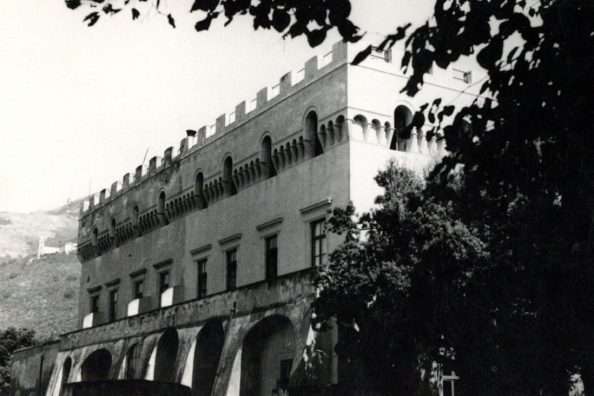
Thanks to the documentation preserved in our historical archive, it is possible to observe the evolution of school buildings. In the past, the boarding school of the Society of Jesus were housed in residences donated by wealthy families, which some adaptation needed work to make them suitable: transforming rooms into classrooms, finding a suitable place for the theatre. Over time, it became necessary to add laboratories. This was the case, for example, at the Collegio dei Nobili in Villa Mondragone. At other times, it was necessary to rebuild a school. Due to the bombings of the Second World War, several buildings were razed to the ground or rendered completely unusable and had to be rebuilt. This was the case with Leone XIII in Milan and Collegio Arici in Brescia.
Have you ever wondered how a school is built?
Rome – Istituto Massimo
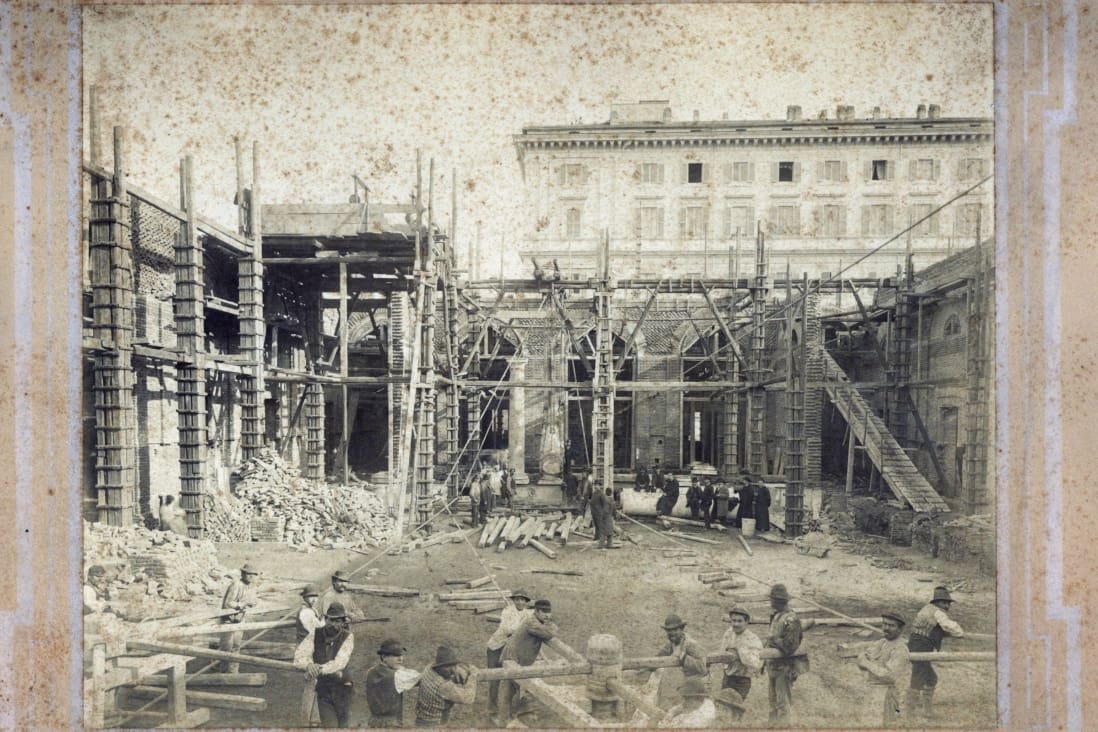
Father Massimiliano Massimo must have asked himself this question more than once when he was informed that the building where he had opened a school in 1879 would be demolished to make way for urban expansion. In fact, between the 1870s and 1880s, the Italian State, of which Rome had become the capital after the fall of the Papal States on 20 September 1870, transformed the city. The banks of the Tiber were built, an operation that would forever change the relationship between the Romans and the river, and wider roads were built, altering the layout of central Rome. Father Massimo had inherited Villa Peretti, a 16th-century family villa, and had adapted its halls and rooms to house the first headquarters of what is now known as the Istituto Massimiliano Massimo, but building a school from scratch was quite another matter. How to proceed?
The answer is now in the files contained in both the Massimo bursar’s office and the community archives, which contain plans, invoices, drawings, floor plans, estimates and letters of recommendation from artists and artisans. Among these files, are the fruits of years of labour by Fr Massimo, who personally supervised the construction of the new building, requesting estimates, evaluating plans and visiting the construction site, as shown in the photograph accompanying today’s episode. The Massimo Institute’s photographic archive contains several photos of Villa Peretti and various photographs of the construction site of the Massimo’s second headquarters.
Although the Jesuit intended the new headquarters to accommodate all future generations of students, it proved unsuitable as early as the 1940s. In fact, the number of students was constantly growing, and the building did not have green spaces or courtyards large enough for the children to play and practise sports. The photographs tell us about the attempts to overcome the problem with various expedients: the boundaries of the football pitch and basketball court were marked with chalk on the courtyard’s brickwork, and a basket was installed on one of the marble columns. To allow the children to practise judo safely, a series of mattresses were laid out in the courtyard. The Jesuits sought an alternative and found it in the EUR district, where they purchased a plot of land and laid the foundation stone for the third and current site of the Massimo. Fr. Giuseppe Massaruti , professor of literature at the Massimo for five decades, studied at this very institute in its former location at Villa Peretti and was present at the blessing of the first stone of the Massimo by Pius XII. However, he never saw the building completed, as he died at the Terme location in 1958.
Institutions destroyed by bombing
The same question that Fr Massimo asked himself in the early 1880s must have been asked by all the Jesuits who, half a century later, found themselves faced with the boarding schools destroyed by bombing during the Second World War and in need of complete reconstruction.
Leone XIII, for example, was completely destroyed by bombing in early September 1944. The Arici boarding school in Brescia was also bombed during the Second World War, suffering extensive damage. Both had to be completely rebuilt.
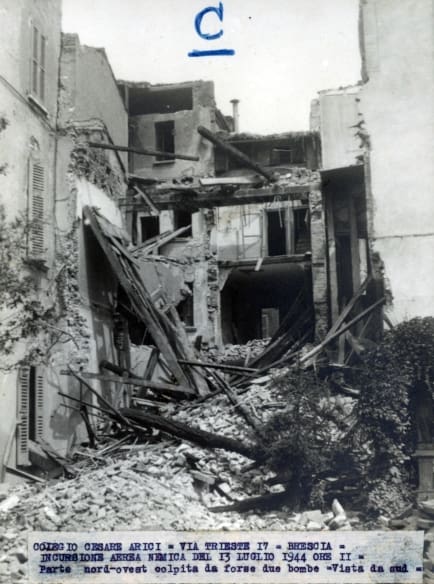
Every institution, whether public or private, could claim compensation for the damage suffered and financial aid for reconstruction. To do so, it was necessary to contact the Civil Engineering Department with documentation proving the damage. Our Archives contain many of these files for damaged residences, all with the same title, ‘War Damage,’ not only for the Second World War but also for the First World War. Among these is the file for the Arici School in Brescia. The file contains technical reports and photographs taken of the building gutted by bombs.
For the Arici boarding school, the archive has both photographs showing the damage caused by the bombing and the plans and floor plans for the construction of the new school. The new school, larger than the previous one, continued to accommodate the students of the Society for another decade. It was then sold to the Diocese of Brescia, which still owns and runs the school that is still located there today. During the years when the school was still run by the Veneto-Milanese Province of the Society of Jesus, the children of Arici wrote some thoughts for the visiting Provincial.
Maria Macchi